An overseas customer ran G.657.A2 cable at Factory A using a certain recipe – pitch, tension, and temperature parameters were all recorded. Later, they set up a new fiber optic cable production line at Factory B and copied the same recipe over, but the cable produced was different: sheath concentricity was on the low side, and stranding pitch occasionally exceeded tolerance.
The customer asked: “The recipe is identical – why are the results different?”
The problem is often not in the recipe itself, but in the equipment’s recipe reproducibility – whether the equipment can stably “execute” a set of process parameters to the letter, and produce the same results across different production lines, different shifts, and different operators.
Today, from the perspective of core equipment functions, let’s discuss recipe reproducibility on an optical fiber cable production line, and how Hongkai, as a Premier Cable Machine Manufacturer, designs equipment so that “the same recipe produces the same result.”
1. Recipe Reproducibility Is Not Just “Writing Down the Numbers”
Many factories understand recipe management as writing down numbers like pitch, tension, and temperature in a notebook, or storing them in Excel. During changeover, they take them out and manually enter them into the equipment.
But that’s just “recipe recording,” not “recipe reproducibility.”
True recipe reproducibility must solve three problems:
First, can the parameters be fully downloaded? A recipe is not just one number for pitch – it also includes pay-off tension, take-up tension, heating zone temperatures, capstan speed, stranding angle, binder yarn tension, and length counter factor. Miss one item, and the result is different.
Second, can the equipment execute it accurately? The recipe says pay-off tension 4.5 N – can the equipment actually hold it stable at 4.5 N? Is the closed-loop response fast enough? Are the sensors accurate? If execution falls short, the recipe is just a piece of paper.
Third, can different production lines produce the same result? Are the SZ stranding lines at Factory A and Factory B – same model – consistent in mechanical rigidity, drive configuration, and control platform? If not, the same recipe will produce different results.
2. Core Function 1: Recipe Storage and One-Touch Loading – Complete Parameter Download
The entire fiber optic cable making machine series features built-in recipe storage, capable of saving complete process parameters for up to 20 different products.
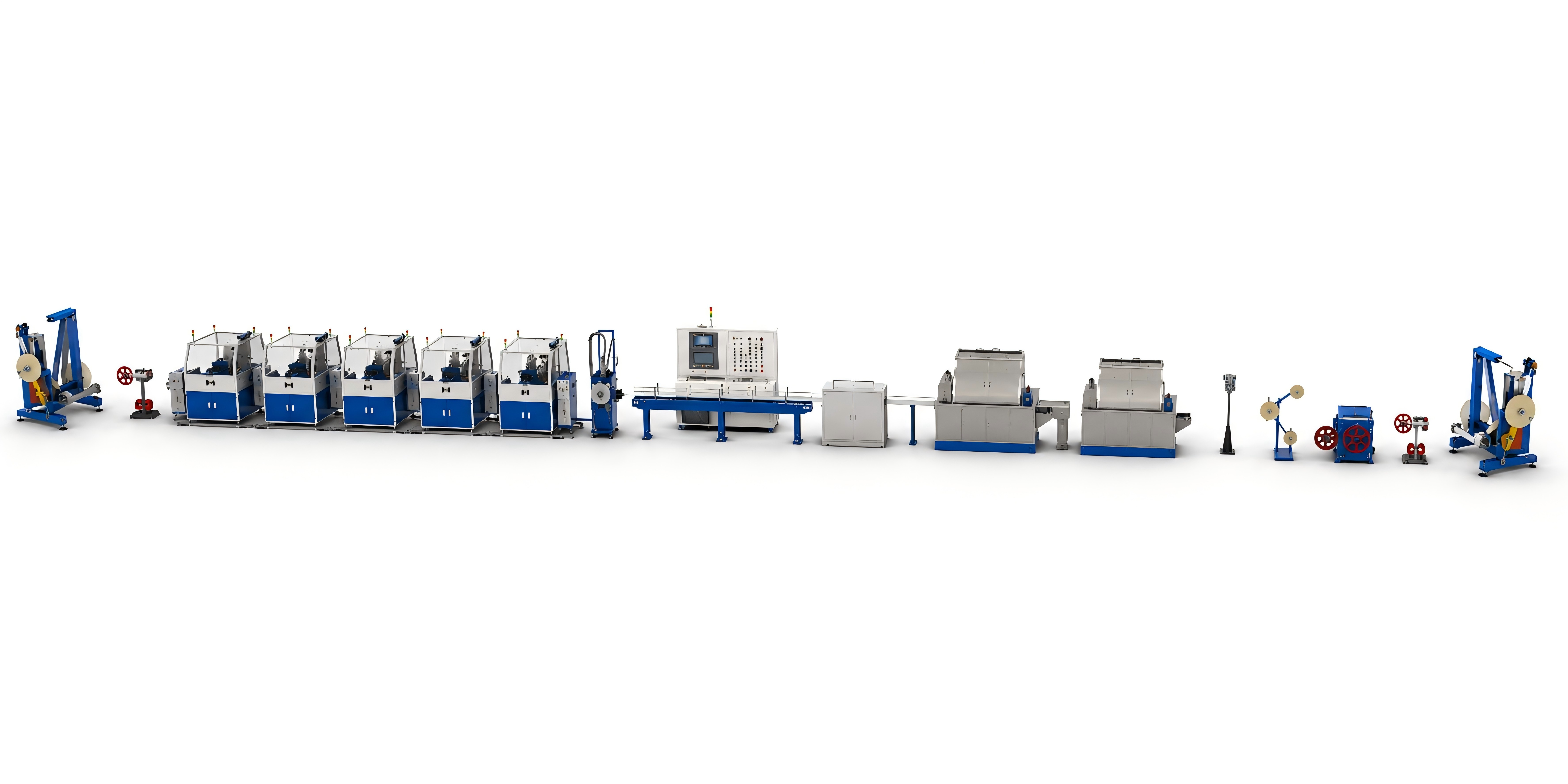
Taking the SZ stranding line as an example, one recipe group includes: stranding pitch, pay-off tension, take-up tension, stranding angle, binder yarn tension, capstan speed, and length counter factor. During changeover, select the product on the touchscreen and tap Load – all parameters are automatically downloaded to each unit, with no need for operators to enter them one by one.
The fiber coloring machine recipe includes pay-off tension, coloring speed, and UV curing energy. The secondary coating line for optical fiber and loose tube line recipes include excess length, capstan speed, hot water trough temperature, and cold water trough temperature. The fiber optic cable sheathing line recipe includes heating zone temperatures, extrusion speed, capstan speed, and concentricity compensation values. The FTTH optical cable manufacturing machine and indoor optical fiber production line recipes include die parameters, pay-off tension, and extrusion temperature.
Complete parameter download is the first step toward recipe reproducibility.
3. Core Function 2: Closed-Loop Control – Executing the Recipe Accurately
Downloading a recipe is just “saying it” – whether the equipment can “do it” depends on closed-loop control.
The pay-off tension of the SZ stranding line uses independent servo motors for active pay-off plus real-time closed-loop tension sensor control, with a signal refresh cycle of 20 milliseconds and pay-off tension fluctuation ≤ ±0.4 N. When the recipe sets 4.5 N, the equipment actually holds stable near 4.5 N – it won’t drift as the pay-off reel diameter changes.
The sheath outer diameter of the fiber optic cable sheathing line uses a laser diameter gauge plus PID closed-loop control. The gauge accuracy is 0.2 μm – if the outer diameter deviates by 0.01 mm, the PLC automatically adjusts extruder speed. The concentricity compensation value set in the recipe is executed by the equipment in real time – 8-hour continuous production concentricity average ≥ 98.6%, wall thickness tolerance ≤ 0.04 mm.
Excess length control on the secondary coating line for optical fiber is closed-loop regulated via the speed differential between front and rear capstans, with excess length control accuracy ±0.2‰. The pay-off tension closed loop on the fiber coloring machine has accuracy ±0.05 N.
Only with closed-loop control in place can the numbers in the recipe become actual precision in the cable. With open-loop control, no matter how accurately the recipe is written, if the equipment can’t execute it accurately, the result will still drift.
4. Core Function 3: Unified PLC Platform – Different Lines Produce the Same Result
Recipe reproducibility has another easily overlooked condition: consistent equipment platform.
If Factory A’s fiber optic cable production line and Factory B’s line have different PLC brands, different control logic, and different sensor accuracy, the same recipe will produce different results.
Hongkai’s entire fiber optic cable making machine series is developed on a unified PLC platform (Siemens/Mitsubishi) – consistent control logic, consistent sensor selection standards, and consistent closed-loop algorithms. When Factory A and Factory B use the same model of equipment, the same recipe produces consistent results.
Full-line data can also be exchanged: excess length data from the secondary coating line for optical fiber is transmitted to the SZ stranding line, and cable core outer diameter data from the SZ stranding line is transmitted to the fiber optic cable sheathing line. With upstream and downstream data connected, recipe execution is more precise.
5. Core Function 4: Permissions and Audit – Recipes Protected from Accidental Modification
Recipe reproducibility also requires preventing “the recipe being changed without anyone knowing.”
Hongkai equipment supports tiered operating permissions: operators can only call up recipes and view data – they cannot modify recipe parameters. Shift supervisors can fine-tune process parameters. Only engineer-level users can modify recipe structures and system parameters. Critical recipes are “locked” behind permissions, so operators can’t accidentally change them.
Recipe modifications are logged: who changed which parameter at what time is traceable in the system. When a customer runs multiple shifts, whether the recipe was changed during shift handover can be checked by reviewing the records.
6. Core Function 5: Data Traceability – Recipe Execution Results Are Verifiable
Recipe reproducibility is not just about “producing the same result” – it’s also about “being able to prove it produced the same result.”
Hongkai equipment comes standard with Siemens/Mitsubishi PLC platforms, supporting automatic production data recording and MES integration. Pay-off tension, stranding pitch, sheath concentricity, and line speed for each batch of cable are automatically recorded, queryable and exportable by batch or by time period.
The optical fiber cable production line is fully data-connected – from the fiber coloring machine to the fiber optic cable sheathing line, the recipe execution results of every process are traceable. When data center customers audit the factory, pull up the data and show it: what recipe this batch of cable used, what the actual executed tension was, what the pitch deviation was, what the concentricity was.
7. The Practical Value of Recipe Reproducibility for Overseas Factories
Value 1: Consistent quality across multiple factories. Factory A and Factory B use the same model of equipment and the same recipe, producing the same cable. When customers build multiple factories overseas, quality doesn’t vary by location.
Value 2: Consistent quality across multiple shifts. Day shift and night shift use the same recipe, with different operators, and the results are the same. No reliance on “the master technician’s feel” – reliance on equipment execution.
Value 3: Fast changeover, less scrap. One-touch recipe loading, complete parameter download – no manual entry, no repeated trial production. Changeover within 1.5 hours, high first article pass rate.
Value 4: Confidence during customer factory audits. Recipe execution data is automatically recorded – retrievable when customers audit the factory.
Value 5: Technical know-how retained in the equipment. Master technicians’ experience becomes recipes stored in the equipment – it doesn’t leave when personnel do.
8. What Should Overseas Buyers Ask When Selecting Equipment?
Question 1: Can the recipe save complete process parameters? Not just pitch, but also tension, temperature, speed, binder yarn tension, and length counter factor.
Question 2: Are critical processes under closed-loop control? Closed-loop tension, outer diameter, and excess length are what enable accurate recipe execution.
Question 3: Is the entire series on a unified PLC platform? A unified platform is what enables different lines to produce the same result.
Question 4: Is there permission control and logging for recipe modifications? Prevents accidental changes, with traceable modifications.
Question 5: Can recipe execution data be automatically recorded and exported? Required for customer factory audits.
📩 Get a Recipe Management and Full-Line Consistency Solution
If you are procuring a fiber optic cable production line for an overseas project, or want to learn about Hongkai equipment’s core functions in recipe storage, closed-loop control, and full-line data traceability, feel free to contact the Hongkai technical team.
Just tell us three things:
-
What type of cable do you want to make? (Loose-tube / FTTH / indoor cable)
-
Do you have multiple factories or multiple lines that need consistent quality?
-
Approximately what capacity? (How many kilometers per month or per year)
We will provide a preliminary equipment configuration proposal, recipe management description, and quotation within 5 working days.
📧 Email: sales2@hkofcmachine.com
🌐 Website: https://hkofcmachine.com/