When procuring a fiber optic cable production line, overseas customers most often ask “what’s the capacity?” But capacity is not a single number – it is jointly determined by the speeds of all the core machines on the line.
The fiber coloring machine can reach 3,000 m/min, the secondary coating line for optical fiber runs at 350 m/min, the SZ stranding line runs at 80 m/min, and the fiber optic cable sheathing line runs at 80 m/min. Fast upstream, slow downstream – the whole line’s capacity is not determined by the fastest machine, but by the slowest core machine.
Today, from the perspective of core equipment selection, let’s discuss the speed chain and capacity matching of an optical fiber cable production line, helping overseas buyers work out “how many machines to buy and how to configure them.” As a Premier Cable Machine Manufacturer, Hongkai helps customers perform capacity matching calculations before signing the contract.
1. Typical Speed Ranges of Each Core Machine
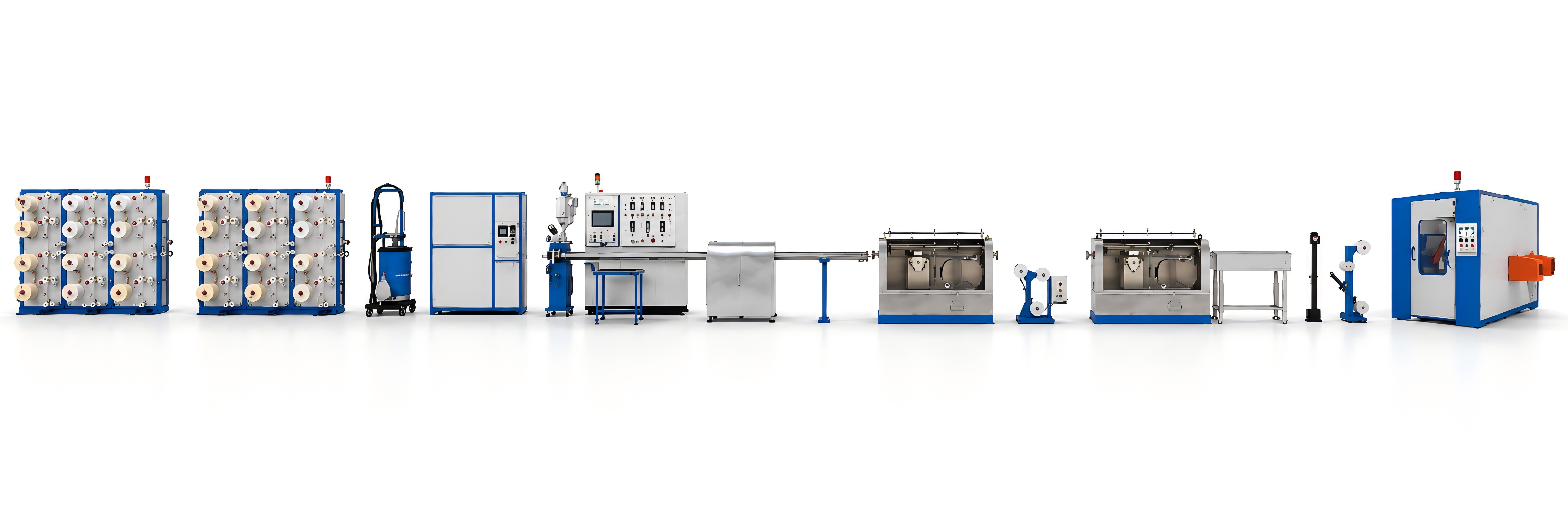
On a complete fiber optic cable production line, the speeds of the core machines vary widely:
| Core Equipment | Typical Speed Range | Hongkai Measured/Design Speed |
|---|---|---|
| Fiber coloring machine / fiber optic coloring line | 1,500–3,000 m/min | 3,000 m/min |
| Secondary coating line for optical fiber / loose tube line | 300–1,000 m/min | 350 m/min |
| SZ stranding line | 60–150 m/min | 80 m/min |
| Fiber optic cable sheathing line | 10–150 m/min | 80 m/min |
| FTTH optical cable manufacturing machine | 50–150 m/min | 100 m/min |
| Indoor optical fiber production line | 50–150 m/min | 100 m/min |
As can be seen, upstream equipment (coloring, secondary coating) runs very fast, while downstream equipment (stranding, sheathing) runs much slower. Stranding and sheathing are the bottleneck processes of the entire line.
2. Working Backward from Annual Capacity to Determine the Number of Core Machines
Assume the customer’s target: annual output of 3,000 km of loose-tube cable, calculated at 300 days per year and 20 hours per day, giving 6,000 operating hours per year.
Step 1: Calculate the required average output speed of the entire line.
3,000 km ÷ 6,000 hours = 0.5 km/hour = 500 m/hour ≈ 8.3 m/min.
This is the required average output speed of the entire line. But the actual production speed of the stranding machine and sheathing line is 80 m/min – far higher than 8.3 m/min. Why? Because equipment cannot run 100% of the time. Changeover, threading, commissioning, and fault downtime mean actual effective operating time may be only 50% to 70%. Calculated at 60%, the actual required production speed is:
8.3 ÷ 0.6 ≈ 13.8 m/min.
Still far below 80 m/min. This shows that one SZ stranding line plus one fiber optic cable sheathing line is sufficient to support an annual capacity of 3,000 km – provided orders are stable and changeovers are infrequent.
Step 2: Calculate how many upstream core machines are needed.
-
Fiber coloring machine: Speed 3,000 m/min. Operating 6,000 hours per year, theoretical capacity = 3,000 × 60 × 6,000 = 1.08 billion meters = 1.08 million km. Far exceeds the 3,000 km requirement. One coloring machine is enough for many years.
-
Secondary coating line for optical fiber / loose tube line: Speed 350 m/min. Annual theoretical capacity = 350 × 60 × 6,000 = 126 million meters = 126,000 km. Also far exceeds 3,000 km. One secondary coating line is also sufficient.
Conclusion: For a loose-tube cable factory with an annual output of 3,000 km, the standard configuration is:
-
Fiber coloring machine: 1 unit
-
Secondary coating line for optical fiber: 1 unit
-
SZ stranding line: 1 unit
-
Fiber optic cable sheathing line: 1 unit
3. Under What Circumstances Should the Number of Core Machines Be Increased?
Scenario 1: Many order varieties and frequent changeovers.
If the customer needs to switch 3 to 5 specifications per day, and the SZ stranding line changeover time is 1.5 hours, that’s 4.5 to 7.5 hours per day spent on changeover. Effective production time drops to only 12.5 to 15.5 hours. In this case, one stranding machine’s capacity is insufficient, and a second one is needed – one running standard specifications, one running changeover specifications, reducing changeover downtime.
Scenario 2: Insufficient downstream capacity, requiring speed increase.
If the customer has a full order book, and the SZ stranding line and fiber optic cable sheathing line are running at full load but still can’t keep up, then:
-
Switch to a higher-speed stranding machine (from 80 m/min to 120 m/min), or
-
Add another stranding machine, or
-
Add another sheathing line.
Scenario 3: Complex product structure requiring dedicated equipment.
If the customer makes both loose-tube cable and FTTH butterfly drop cable, then:
-
SZ stranding line + fiber optic cable sheathing line (for loose-tube)
-
FTTH optical cable manufacturing machine (for butterfly drop cable)
-
Possibly also an indoor optical fiber production line (for indoor cable)
4. Common Misconceptions About Core Equipment Speed Matching
Misconception 1: Buy the fastest machine for every process.
Buy a fiber coloring machine at 3,000 m/min, a secondary coating line for optical fiber at 1,000 m/min, and an SZ stranding line at 150 m/min – the upstream speed far exceeds the downstream, so the upstream equipment sits idle most of the time, wasting investment. Core equipment speeds must match – faster is not always better.
Misconception 2: Calculate only theoretical capacity, not effective operating time.
Theoretical capacity is “line speed × 24 hours”; actual capacity must deduct changeover, downtime, and commissioning time. Configuring equipment based on theoretical capacity leads to insufficient capacity during peak season.
Misconception 3: Ignore the impact of changeover frequency on capacity.
With many order varieties and frequent changeovers, the effective capacity of a single machine drops significantly. The entire fiber optic cable making machine series features one-touch recipe loading, with changeover within 1.5 hours – already much faster than traditional equipment. But if changeover frequency is too high, the number of machines still needs to be increased.
5. How Does Hongkai Help Customers with Capacity Matching?
Before signing the contract, Hongkai helps customers work out a “capacity account”:
First, confirm product type and capacity target. What cable does the customer make? How many kilometers per year?
Second, calculate the requirements of each process. Based on product type and capacity target, work backward to determine the number and speed of each core machine.
Third, analyze the bottleneck process. Identify the slowest link in the entire line and recommend that the customer add equipment or increase automation.
Fourth, consider changeover efficiency. If the customer has many order varieties, recommend adding stranding machines or choosing equipment with faster changeover.
Fifth, reserve expansion space. The entire fiber optic cable making machine series uses modular design – future capacity expansion only requires adding modules, not replacing entire machines.
6. A Real Capacity Matching Case Study
Last year, a Middle Eastern customer wanted to build a cable factory with an annual output of 5,000 km, mainly making loose-tube outdoor cable, with many order varieties and 2 to 3 specification changes per day.
Hongkai worked out the calculation for him:
-
SZ stranding line speed 80 m/min, changeover 1.5 hours per change, 2 changeovers per day = 3 hours. Effective operating time 17 hours. Daily capacity = 80 × 60 × 17 = 81,600 meters = 81.6 km. Annual capacity (300 days) = 24,480 km. One stranding machine is sufficient.
-
But the customer has many order varieties and frequent changeovers, so it was recommended to configure 2 stranding machines – one running standard specifications, one running changeover specifications. This reduces changeover downtime.
-
Fiber optic cable sheathing line speed 80 m/min – likewise configure 2 units.
-
Upstream fiber coloring machine and secondary coating line for optical fiber – 1 unit each, sufficient to support downstream capacity.
The customer ultimately adopted the recommendation, configuring 2 SZ stranding lines and 2 fiber optic cable sheathing lines, plus 1 fiber coloring machine and 1 secondary coating line for optical fiber. After production launch, changeover time was greatly reduced, and capacity met expectations.
7. What Should Overseas Buyers Ask When Selecting Core Equipment?
Question 1: What is the actual production speed of each core machine? Don’t just look at maximum speed – look at actual stable operating speed.
Question 2: How long is changeover? Can recipes be loaded with one touch? Fast changeover means high effective capacity.
Question 3: How is the full-line speed matched? Will upstream be excessive or downstream be a bottleneck? The supplier should calculate this for you.
Question 4: Given the capacity target, how many units of each core machine are needed? Calculated based on product type, capacity target, and changeover frequency.
Question 5: Can the equipment be expanded modularly? Future capacity expansion only requires adding modules, not replacing the entire line.
8. Hongkai Core Equipment Speed and Capacity Configuration
| Core Equipment | Hongkai Speed | Matching Recommendation |
|---|---|---|
| Fiber coloring machine | 3,000 m/min | 1 unit can support multiple downstream lines |
| Secondary coating line for optical fiber / loose tube line | 350 m/min | 1 unit matches 1–2 stranding machines |
| SZ stranding line | 80 m/min | Configure 1–2 units based on changeover frequency |
| Fiber optic cable sheathing line | 80 m/min | Configure 1–2 units based on changeover frequency |
| FTTH optical cable manufacturing machine | 100 m/min | Dedicated for butterfly drop cable, configured independently |
| Indoor optical fiber production line | 100 m/min | Dedicated for indoor cable, configured independently |
📩 Get a Capacity Matching Calculation and Core Equipment Configuration Proposal
If you are procuring a fiber optic cable production line for an overseas project, or want to learn about Hongkai’s methods for core equipment speed matching and capacity calculation as a Premier Cable Machine Manufacturer, feel free to contact the Hongkai technical team.
Just tell us three things:
-
What type of cable do you want to make? (Loose-tube / FTTH / indoor cable)
-
What is your target annual capacity in kilometers?
-
Are there many order varieties? How many changeovers per day?
We will provide a preliminary core equipment configuration proposal, capacity matching calculation, and quotation within 5 working days.
📧 Email: sales2@hkofcmachine.com
🌐 Website: https://hkofcmachine.com/