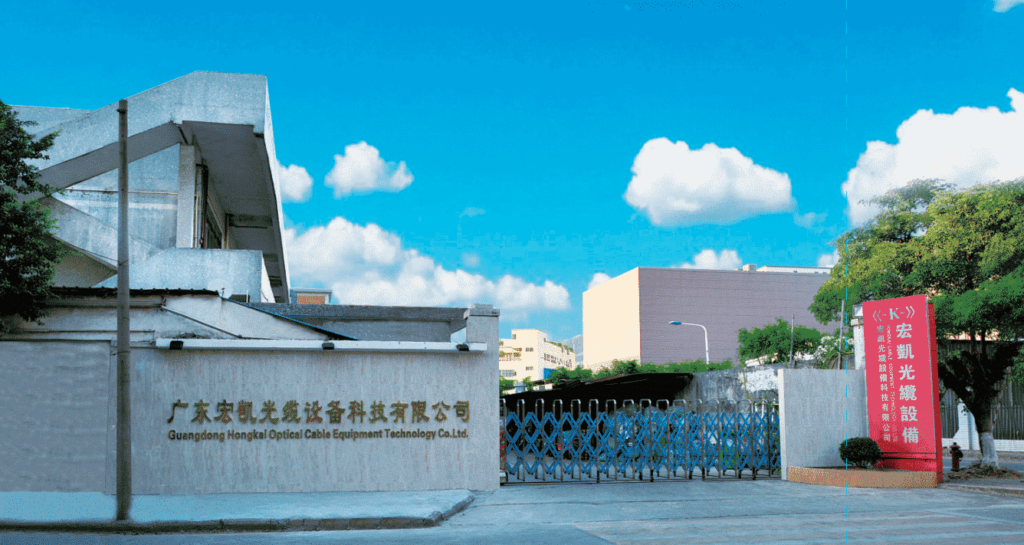
The equipment has arrived at port, the factory is ready, and the power is connected – now what?
Many overseas customers feel most anxious about the “first startup” after a fiber optic cable production line arrives at their factory. Will the equipment run? Are the parameters correct? Will it alarm as soon as it’s powered on?
Today, using an SZ stranding line and a fiber optic cable sheathing line as examples, let’s walk through the eight steps of first startup. Following this process, from unpacking to producing the first qualified reel of cable typically takes 12 to 18 days.

Step 1: Unpacking Inspection – Don’t Rush to Open; Verify First
After the equipment arrives at the factory, don’t rush to open the packaging. First, check against the packing list:
-
Does the equipment model and quantity match the contract?
-
Are there any signs of damage or water ingress on the crates?
-
Is there any obvious damage to critical components (differential gearbox, extruder screw, laser diameter gauge)?
If problems are found, take photos and videos on the spot and contact the manufacturer immediately. Do not raise the issue after signing the delivery receipt – at that point, liability becomes difficult to assign.
Every Hongkai fiber optic cable making machine comes with a packing list and factory test report. After unpacking, customers can re-measure against the data.
Step 2: Power Confirmation – Voltage, Frequency, Phase Sequence – None Can Be Wrong
Voltage systems vary significantly across overseas markets. North America 480V/60Hz, Europe 400V/50Hz, Southeast Asia 230V/50Hz.
Confirm three things:
-
Does the voltage match the equipment nameplate?
-
Does the frequency match (50Hz or 60Hz)?
-
Is the phase sequence correct? (Reversed three-phase wiring causes the motor to run backwards.)
Hongkai confirms the customer’s factory voltage and frequency at the contract stage and completes adaptation before factory release. The complete fiber optic cable production line requires approximately 80–120 kW of power.
Step 3: Mechanical Inspection – Couplings, Belts, Lubrication Points
Before powering on, perform a mechanical inspection.
-
Is the coupling between the differential gearbox and the main motor aligned? (Deviation ≤ 0.05 mm)
-
Is the drive belt tension appropriate? (Depression of 10–15 mm when pressed)
-
Have all lubrication points been greased?
-
Are the protective guards properly installed?
For the fiber optic cable sheathing line, the extruder, cooling trough, capstan, and take-up must be on the same centerline, with deviation not exceeding 2 mm.
Step 4: No-Load Trial Run – Each Unit Running Individually
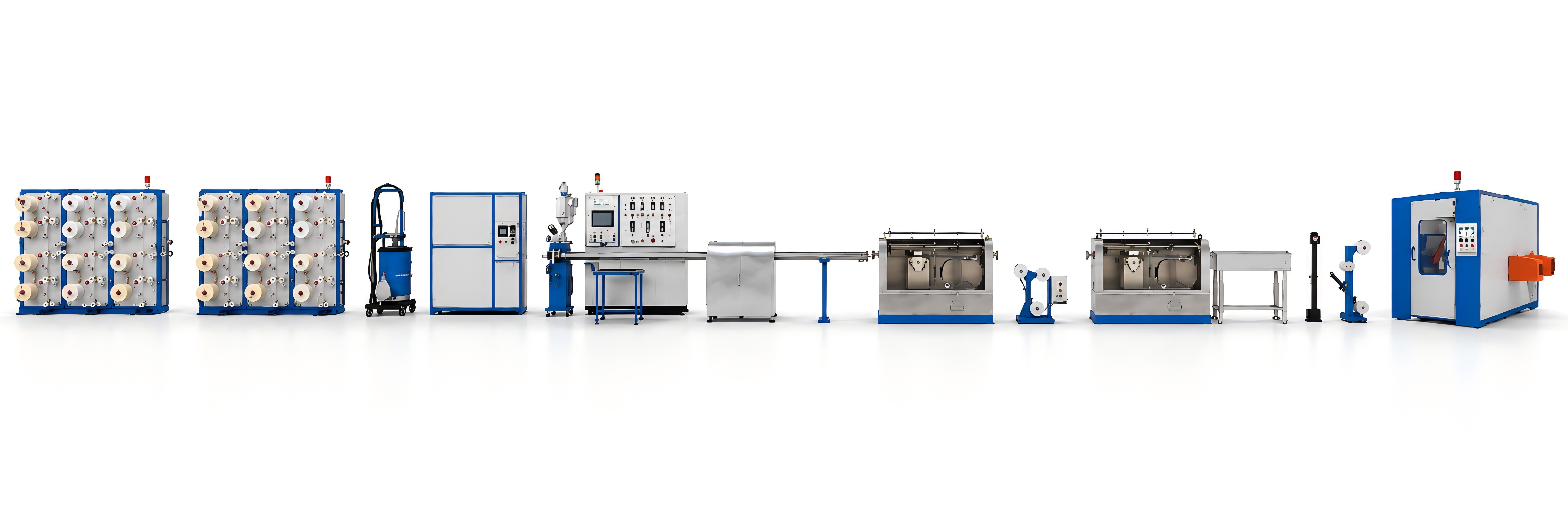
After powering on, perform a no-load trial run first. Without feeding tubes or sheath material, run each unit of the equipment individually.
-
Fiber coloring machine: Does the pay-off rotate? Does the dancer arm move freely?
-
Secondary coating line for optical fiber: Does the extruder heat properly?
-
Loose tube line: Is the capstan speed stable?
-
SZ stranding line: Does the stranding unit reverse smoothly?
-
Fiber optic cable sheathing line: Is the take-up traverse even?
The fiber optic coloring line and FTTH optical cable manufacturing machine are checked following the same process.
Step 5: Parameter Settings – One-Touch Recipe Loading
Once no-load operation is fine, set the process parameters.
Hongkai equipment features built-in recipe storage, capable of saving process parameters for up to 20 different products. The operator selects the corresponding product on the touchscreen and taps “Load” – all parameters are automatically sent to each unit. All machines on the indoor optical fiber production line and optical fiber cable production line support one-touch recipe loading, compressing changeover time to under 1.5 hours.
Step 6: Load Trial Run – Feed Material, Start at Low Speed
Feed actual tubes and sheath material, starting at low speed.
Watch three data points:
-
SZ stranding line pay-off tension fluctuation (industry standard ≤ ±0.5 N, Hongkai measured ≤ ±0.4 N)
-
Stranding pitch deviation (industry standard ≤ ±0.1 mm, Hongkai measured ≤ ±0.08 mm)
-
Fiber optic cable sheathing line concentricity (industry standard ≥ 98%, Hongkai measured ≥ 98.6%)
If problems are found, adjust promptly – don’t wait until running fast to go back and check.
Step 7: Operator Training – Until They’ve Got It
Once the equipment runs, operators must be able to operate it independently.
Hongkai engineers go on-site for installation and commissioning – 12 to 18 days from unpacking to producing the first qualified reel. Training covers three levels:
-
Operational level: Startup, changeover, parameter adjustment, daily inspection
-
Maintenance level: Common troubleshooting, spare part replacement
-
Data level: Data export, MES integration
Before the engineers leave, ensure operators can independently complete a changeover.
Step 8: Acceptance Sign-Off – It’s Not Done Until the Data Matches
The final step: acceptance.
The customer measures with instruments: pay-off tension fluctuation, stranding pitch deviation, sheath concentricity. Compare against the data on Hongkai’s factory test report – if the numbers match, the equipment’s precision is proven.
Document handover checklist:
-
Factory test report
-
PLC program backup USB drive
-
Electrical schematics
-
Bilingual operation manuals (Chinese/English)
-
Wear-parts kit list
-
Training records
-
Acceptance report
📩 Get First Startup Technical Support
If you are building a cable factory overseas, your equipment is about to arrive, and you need technical guidance for first startup, feel free to contact the Hongkai technical team.
Just tell us three things:
-
What type of cable do you want to make? (Loose-tube / FTTH / indoor cable)
-
Where will the factory be built? (This affects voltage system and certification requirements)
-
When will the equipment arrive at the factory?
We will provide a startup inspection checklist and engineer on-site arrangements within 5 working days.
📧 Email: sales2@hkofcmachine.com
🌐 Website: https://hkofcmachine.com/