Recently, I’ve noticed that when customers select equipment, their attention is all on the extruder, screw, and laser diameter gauge. Few seriously ask: “What is the water temperature control accuracy of the cooling trough? Are there water quality requirements?”
But cooling water is precisely the “final checkpoint” for sheath quality. When plastic comes out of the extruder, it is in a molten state and is shaped by the cooling trough. If the water temperature is too high, the sheath cools slowly, crystallinity is insufficient, the surface becomes tacky, and dimensions become unstable. If the water temperature is too low, cooling is too fast, internal stress is high, and the sheath is prone to cracking. A 2°C fluctuation in water temperature can cause sheath concentricity and wall thickness tolerance to exceed limits.
Today let’s talk about the cooling system on a fiber optic cable production line, and how overseas factories can manage cooling water properly. As a Premier Cable Machine Manufacturer, Hongkai has a mature solution for cooling system configuration and maintenance.
1. Which Equipment Requires Cooling Water?
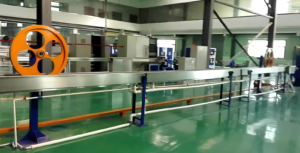
The cooling trough of a fiber optic cable sheathing line is the largest cooling water user. The cable core exits the extruder die head, passes through the cooling trough for shaping, and then enters the capstan and take-up.
The hot water trough and cold water trough of the secondary coating line for optical fiber and loose tube line also require temperature control. The hot water trough allows PBT to fully crystallize, and the cold water trough sets the loose tube.
The UV-LED curing system of the fiber coloring machine requires cooling water (or air cooling) to remove heat, ensuring UV lamp life and curing stability.
The SZ stranding line itself does not require cooling water, but if the workshop’s cooling water circulation system has unstable pressure, it may affect adjacent equipment.
2. What Happens to the Sheath When Cooling Water Has Problems?
Problem 1: Water temperature too high. The sheath cools slowly, the surface becomes tacky, and it easily sticks during take-up. Wall thickness becomes uneven, and concentricity drops. The concentricity of the fiber optic cable sheathing line may drop from 98.6% to below 97%.
Problem 2: Water temperature too low. Cooling is too fast, internal stress in the sheath is high, and it is prone to cracking during subsequent installation. LSZH materials are particularly sensitive to cooling rate.
Problem 3: Large water temperature fluctuation. If the temperature difference between the inlet and outlet of the cooling trough is large, the cooling rate of the front and rear sections of the sheath is inconsistent, causing outer diameter fluctuation. The laser diameter gauge on the optical fiber cable production line will show outer diameter jumping.
Problem 4: Poor water quality. Impurities, algae, and scale in the water clog the spray holes of the cooling trough, causing localized poor cooling of the sheath. Scale adhering to the inner walls of the cooling trough affects heat exchange efficiency.
Problem 5: Insufficient flow. If the water pump is undersized or the piping is clogged, cooling water flow is insufficient, and the sheath is not adequately cooled.
3. Hongkai Equipment Cooling System Configuration
First, water temperature control. The cooling trough of the fiber optic cable sheathing line is recommended to be equipped with a chiller, with water temperature control accuracy of ±1°C. Customers can choose based on local climate and product requirements. Hongkai confirms the customer’s factory water source conditions and ambient temperature at the contract stage and recommends a suitable cooling solution.
Second, water quality requirements. Cooling water should use softened or deionized water to avoid scale. Impurity particle size in water should be ≤ 50 μm. Customers can install filters on the cooling water circulation piping and clean them periodically.
Third, flow monitoring. The cooling trough is equipped with a flow switch that alarms when flow is insufficient. Water pump selection is calculated based on cooling trough volume and heat exchange requirements, with sufficient margin.
Fourth, water temperature display. Inlet and outlet water temperatures of the cooling trough are displayed in real time on the touchscreen. Operators can visually see water temperature changes.
Fifth, circulation. Customers are recommended to use a circulating water system, where cooling water is cooled through a heat exchanger and reused, saving water. The UV cooling water of the fiber optic coloring line is also recommended to be circulated.
Sixth, freeze protection design. For customers in low-temperature regions, the cooling water system should include freeze protection measures. Drain the piping during shutdown, or add antifreeze. The cooling water systems of the entire fiber optic cable making machine series can be configured for low-temperature environments.
4. Daily Cooling Water Maintenance Checklist for Overseas Factories
Daily: Check whether the cooling trough water temperature is within the set range on the touchscreen display. Check the flow switch for alarms.
Weekly: Check cooling water quality for turbidity or impurities. Clean the filter.
Monthly: Clean the inner walls of the cooling trough to remove scale and impurities. Check water pump operating sound and current.
Quarterly: Check chiller cooling performance and clean the condenser. Check piping for leaks.
Semi-annually: Replace cooling water (if using a non-circulating system). Check heat exchanger efficiency.
Annually: Check water pump seals and replace worn parts. Every Hongkai machine comes with a standard wear-parts kit; water pump seals and filter cartridges can be stocked as needed. For major parts, DHL delivery within three days.
5. What Should Overseas Buyers Ask When Selecting Equipment?
Question 1: What is the water temperature control accuracy of the cooling trough? ±1°C or better is recommended.
Question 2: Is a chiller included? Recommended for regions with high ambient temperatures.
Question 3: Can water temperature be seen in real time on the touchscreen? Hongkai equipment comes standard with water temperature display.
Question 4: Are there water quality requirements for cooling water? Softened or deionized water, with a filter.
Question 5: Is there freeze protection design for low-temperature regions? The cooling water system can be drained or filled with antifreeze.
The cooling systems of all machines on the fiber optic cable production line – fiber coloring machine, fiber optic coloring line, secondary coating line for optical fiber, loose tube line, SZ stranding line, fiber optic cable sheathing line, FTTH optical cable manufacturing machine, indoor optical fiber production line – are configured and maintained to the same standard.
6. Real Feedback from a Southeast Asian Customer
Last year, a Vietnamese customer reported that the sheath surface on their fiber optic cable sheathing line was occasionally tacky and concentricity was fluctuating. Hongkai engineers remotely reviewed the data and found that the cooling trough outlet water temperature was 8°C higher than the inlet – clearly too high. The customer inspected and found that the chiller condenser was dirty, reducing cooling performance. After cleaning the condenser, water temperature returned to normal, the sheath surface became smooth, and concentricity returned to 98.6%.
The customer later said on WhatsApp: “I used to only watch the extruder and diameter gauge. I never thought cooling water could affect sheath quality.”
📩 Get a Cooling System Configuration Proposal and Maintenance Checklist
If you are procuring a fiber optic cable production line for an overseas project, or want to learn about Hongkai equipment’s cooling system configuration and maintenance solutions, feel free to contact the Hongkai technical team.
Just tell us three things:
-
What type of cable do you want to make? (Loose-tube / FTTH / indoor cable)
-
Where will the factory be built? (This affects ambient temperature and water source conditions)
-
Approximately what capacity? (How many kilometers per month or per year)
We will provide a preliminary equipment configuration proposal, cooling system description, and quotation within 5 working days.
📧 Email: sales2@hkofcmachine.com
🌐 Website: https://hkofcmachine.com/