Customers often ask: “I’ve bought all the equipment – why doesn’t the production line run smoothly?”
Individually, every machine looks fine – the fiber coloring machine runs at 3,000 m/min, the SZ stranding line has tension fluctuation ≤ ±0.4 N, and the fiber optic cable sheathing line achieves 98.6% concentricity. Each one meets the standard. But when they’re connected and running together, something is off.
The problem lies in collaboration.
A complete fiber optic cable production line is not just several machines placed together. They need to “talk” to each other – speeds must match, tensions must connect, and data must be exchanged. Today let’s discuss how the machines on a cable production line work together, and what problems arise when collaboration fails.

1. First Dialogue: Speed Matching Between the Fiber Coloring Machine and the Secondary Coating Line
The fiber coloring machine is the starting point of a cable production line. Its job is to apply one of 12 standard colors to transparent fiber and then rewind it onto reels.
The coloring machine runs fast – industry mainstream is 1,500 to 3,000 m/min, and Hongkai’s fiber optic coloring line can reach 3,000 m/min.
But the next process, the secondary coating line for optical fiber, also called the loose tube line, runs at only about 350 m/min.
Here’s the problem: one day of work from the coloring machine takes several days for the secondary coating line to process.
If the customer doesn’t look at the speeds of these two processes together when buying equipment, they’ll end up with the awkward situation of “upstream overcapacity, downstream insufficient capacity.” No matter how fast the coloring machine runs, if the downstream can’t keep up, it’s wasted.
How to collaborate?
-
The coloring machine can run at reduced speed to match downstream capacity.
-
Or multiple secondary coating lines can be configured to “absorb” the upstream capacity.
-
Hongkai helps customers calculate this during the plant planning stage to avoid speed mismatches between upstream and downstream.
2. Second Dialogue: Tension Continuity Between the Secondary Coating Line and the SZ Stranding Line
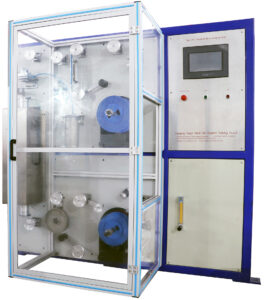
The secondary coating line for optical fiber turns colored fiber into loose tubes filled with gel. The excess length control accuracy of the loose tube is ±0.2‰.
This excess length data is an “input parameter” for the next process – the SZ stranding line.
Here’s the problem: if the excess length from secondary coating is not properly controlled, the fiber excess length will be thrown off during stranding.
The stranding pitch, pay-off tension, and take-up tension of the stranding process are all set based on the excess length from secondary coating. If the excess length is off, no matter how precise the stranding machine is, it can’t fix it. The final cable will exceed limits in additional attenuation during temperature cycling tests.
How to collaborate?
-
The excess length data from secondary coating must be transmitted to the stranding machine.
-
The pay-off tension of the stranding machine must automatically adjust based on excess length.
-
Hongkai’s unified PLC platform allows data exchange between the loose tube line and the SZ stranding line.
3. Third Dialogue: Speed Synchronization Between the SZ Stranding Line and the Fiber Optic Cable Sheathing Line
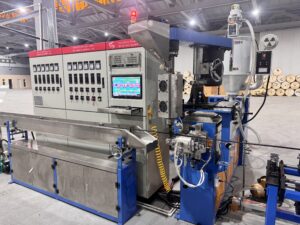
The SZ stranding line strands loose tubes and strength members into a cable core, which is then wound onto reels. The cable core then enters the fiber optic cable sheathing line to be covered with a sheath.
Here’s the problem: if the take-up speed of the stranding machine doesn’t match the pay-off speed of the sheathing line, the cable core will have inconsistent tightness.
If the core is too loose, the sheath won’t fit snugly. If the core is too tight, the sheath will have residual stress. The final result is sheath concentricity deviation and uneven wall thickness.
How to collaborate?
-
There must be a speed synchronization signal between the stranding machine and the sheathing line.
-
When the capstan speed of the sheathing line changes, the take-up speed of the stranding machine must follow synchronously.
-
All machines on Hongkai’s fiber optic cable production line are developed on a unified PLC platform (Siemens/Mitsubishi), supporting PROFINET and MODBUS TCP/IP protocols, so speeds can match and data can be exchanged.
4. Fourth Dialogue: Data Exchange Across the Entire Line
Beyond speed matching and tension continuity, the machines on an entire optical fiber cable production line also need “data dialogue.”
If the entire fiber optic cable making machine series – including the fiber coloring machine, fiber optic coloring line, secondary coating line for optical fiber, loose tube line, SZ stranding line, fiber optic cable sheathing line, FTTH optical cable manufacturing machine, and indoor optical fiber production line – is based on the same PLC platform, data can flow automatically.
What problems does data exchange solve?
-
Recipe storage: During changeover, the entire line loads with one touch – no need to set parameters machine by machine.
-
Production traceability: Process parameters for every batch of cable are automatically recorded – available for customer factory audits.
-
Fault diagnosis: Which machine has a problem, what the cause is, and how to check it – all clear in the system.
-
MES integration: Full-line data upload – managers can see production line status from their office.
5. What Happens When Collaboration Is Poor?
Problem 1: Pitch deviation exceeds tolerance. The pay-off tension and capstan speed of the stranding machine don’t match, causing stranding pitch to vary. Industry standards require pitch deviation ≤ ±0.1 mm; poor collaboration can push it to ±0.3 mm.
Problem 2: Sheath eccentricity. When the cable core enters the sheathing line with unstable tension, sheath concentricity drops from 98% to below 95%. Orders for G.657 series cables can no longer be taken.
Problem 3: Long changeover time. When machine parameters are not linked, changeover requires manual entry machine by machine – four or five hours and still not done. Hongkai equipment features one-touch recipe loading, with full-line changeover in under 1.5 hours.
Problem 4: Data mismatch. Upstream equipment data cannot reach downstream equipment, breaking the production traceability chain. When data center customers audit the factory, a complete “production file” cannot be provided.
6. How Do Hongkai Machines “Talk”?
Unified PLC platform. All equipment is developed on Siemens/Mitsubishi PLCs, supporting PROFINET and MODBUS TCP/IP protocols.
Recipe storage and one-touch loading. Process parameters for up to 20 different products can be saved. During changeover, the entire line loads with one touch – done in 1.5 hours.
Data acquisition and MES integration. Production data is automatically recorded, supporting OPC UA or SQL interfaces for MES integration.
Speed matching and tension continuity. The stranding machine and sheathing line achieve speed synchronization via industrial Ethernet, keeping cable core tension stable.
Remote diagnostics. An optional remote access module (with customer authorization) allows engineers to remotely view full-line equipment operating status and diagnose alarm causes.
📩 Get a Complete Line Collaboration Solution
If you are procuring a fiber optic cable production line for an overseas project, or want to learn how Hongkai equipment achieves full-line collaboration and avoids the problem of “each machine meets the standard, but the line doesn’t run smoothly,” feel free to contact the Hongkai technical team.
Just tell us three things:
-
What type of cable do you want to make? (Loose-tube / FTTH / indoor cable)
-
Where will the factory be built? (This affects voltage system and certification requirements)
-
Approximately what capacity? (How many kilometers per month or per year)
We will provide a preliminary equipment configuration proposal, full-line collaboration description, and quotation within 5 working days.
📧 Email: sales2@hkofcmachine.com
🌐 Website: https://hkofcmachine.com/