Over the years of exporting cable equipment, I’ve seen too many customers fall into the same pit: buying equipment one machine at a time, and piecing together a production line one segment at a time.
A fiber coloring machine bought from Supplier A, a secondary coating line for optical fiber from Supplier B, an SZ stranding line from Supplier C, and a fiber optic cable sheathing line from Supplier D. Individually, none of the machines’ parameters look bad, but when assembled together, the line doesn’t run smoothly: speeds don’t match, interfaces aren’t compatible, data can’t be transmitted, and when problems arise, the suppliers blame each other.
An optical fiber cable production line is not a simple stacking of several machines. From fiber coloring to finished cable take-up, it passes through multiple processes, and the speed, tension, temperature, and data of every process must connect seamlessly. If the connections are poor, no matter how high the precision of individual machines, the whole line won’t produce good products.
Today let’s talk about the value of a “one-stop” solution for overseas cable factories, and how Hongkai, as a Premier Cable Machine Manufacturer, approaches complete line delivery.
1. What Goes Wrong When You Piece Together a Line Machine by Machine?
Problem 1: Speed mismatch.
The fiber optic coloring line runs at 3,000 m/min, while the loose tube line runs at 350 m/min. One day of work from the coloring machine takes the secondary coating line several days to process. If customers configure the line themselves without calculating this, the equipment they buy ends up with an idle front end and a bottleneck at the back end.
Problem 2: Incompatible interfaces.
The SZ stranding line uses Brand A PLC, while the fiber optic cable sheathing line uses Brand B PLC. Data formats are inconsistent and communication protocols are incompatible. To link them, you need to add gateways, modify programs, and re-commission – time-consuming and labor-intensive.
Problem 3: Poor tension continuity.
The excess length data from the secondary coating line for optical fiber is the “input parameter” for the SZ stranding line. If excess length is not properly controlled, fiber stress becomes uneven during stranding. If the two machines come from different manufacturers, data can’t be transmitted – the stranding machine doesn’t know the upstream excess length and can only run on default values, degrading precision.
Problem 4: Blame-shifting when problems arise.
The stranding machine says “the upstream tubes are no good,” the upstream says “the stranding machine’s tension is unstable,” and the sheathing line says “the cable core isn’t round.” The customer is caught in the middle, unable to find the responsible party, waiting weeks for each supplier to send someone.
2. What Problems Does a One-Stop Solution Solve?
Advantage 1: Full-line speed matching calculation.
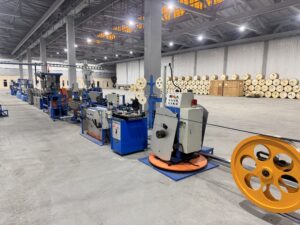
Before signing the contract, Hongkai helps customers calculate full-line speed matching. The entire fiber optic cable making machine series – fiber coloring machine, fiber optic coloring line, secondary coating line for optical fiber, loose tube line, SZ stranding line, fiber optic cable sheathing line, FTTH optical cable manufacturing machine, indoor optical fiber production line – has each unit’s speed configured according to the customer’s capacity target, so the front end isn’t idle and the back end isn’t a bottleneck.
Advantage 2: Unified PLC platform, data exchange.
Hongkai’s entire series is developed on Siemens/Mitsubishi PLC platforms, supporting PROFINET and MODBUS TCP/IP protocols. Unit speeds are linked, data is exchanged, and recipes load with one touch. The optical fiber cable production line is fully data-connected – managers can see line status from their office.
Advantage 3: Tension continuity supported by data.
Excess length data from the secondary coating line for optical fiber can be transmitted to the SZ stranding line. The stranding machine automatically adjusts pay-off tension based on excess length – no need to manually set default values. Full-line tension continuity is supported by data, providing more reliable pitch stability.
Advantage 4: One party responsible, no blame-shifting.
When the entire line comes from the same supplier, you go to one party when problems arise. Hongkai engineers go on-site for installation and commissioning, getting the entire fiber optic cable production line running – 12 to 18 days from unpacking to producing the first qualified reel. Customers don’t need to coordinate multiple suppliers – saving time and hassle.
Advantage 5: Common spare parts, simple management.
The entire series uses unified electrical components and mechanical spare parts, reducing the variety of spare parts customers need to stock. The sensors on the SZ stranding line and the fiber optic cable sheathing line are the same model – one spare covers multiple machines. Every Hongkai machine comes with a standard wear-parts kit, and spare parts arrive via DHL within three days.
3. What Does Hongkai Specifically Do for Complete Line Delivery?
First, capacity planning. Based on the customer’s product type and capacity target, calculate the number and speed configuration of equipment for each process. How to configure when the front end is fast and the back end is slow? How to add equipment when changeover frequency is high? Hongkai helps customers calculate this clearly before signing the contract.
Second, equipment manufacturing. The entire fiber optic cable making machine series is manufactured, tested, and factory-inspected at Hongkai’s factory. Every machine comes with a factory test report – pay-off tension fluctuation, stranding pitch deviation, sheath concentricity – all data listed.
Third, full-line commissioning. After the equipment arrives at the customer’s factory, Hongkai engineers install and commission it, matching unit speeds, enabling signal exchange, and running the line in linked mode. The line is not considered delivered until it runs through and produces the first qualified reel of cable.
Fourth, operator training. Training covers three levels: operational (startup, changeover, parameter adjustment), maintenance (common troubleshooting, spare part replacement), and data (data export, MES integration). Before the engineers leave, ensure operators can independently complete a changeover.
Fifth, after-sales support. Remote video support with a 2-hour response time during working hours. Equipment can optionally be equipped with a remote access module, allowing engineers to remotely view equipment status and diagnose alarm causes. In 2024, Hongkai completed 89 overseas remote video support sessions, with an average resolution time of 32 minutes. Spare parts arrive via DHL within three days; major electrical components use international brands with global warranty coverage and locally available replacements.
4. The Practical Value of a One-Stop Solution for Overseas Factories
Value 1: Saves time. No need to coordinate multiple suppliers or wait for each to send people for commissioning. Hongkai handles complete line delivery – production in 12 to 18 days.
Value 2: Saves cost. Full-line speed matching means the front end isn’t idle and the back end isn’t a bottleneck. High equipment utilization and fast return on investment.
Value 3: Stable precision. Unified PLC platform, data exchange, and tension continuity supported by data. SZ stranding line pay-off tension fluctuation ≤ ±0.4 N, fiber optic cable sheathing line concentricity ≥ 98.6% – full-line precision is stable.
Value 4: Simple management. Common spare parts, data exchange, one after-sales contact. Customers don’t need to remember multiple suppliers’ contact information or stock multiple models of spare parts.
Value 5: Easy expansion. Modular design means customers can add modules for future capacity expansion without replacing the entire line. All machines on the optical fiber cable production line support future expansion.
5. What Should Overseas Buyers Ask When Selecting a Supplier?
Question 1: Can you perform full-line speed matching calculations? A one-stop supplier will calculate it for you; a single-machine supplier only sells individual machines.
Question 2: Is the entire series on a unified PLC platform? A unified platform is what enables data exchange.
Question 3: Who is responsible for full-line installation and commissioning? A one-stop supplier is responsible for getting the entire line running; single-machine suppliers each handle their own.
Question 4: Are spare parts common across machines? Common spare parts mean fewer types to stock.
Question 5: Who do I contact when problems arise? A one-stop supplier takes responsibility – no blame-shifting.
📩 Get a Complete Line Delivery Proposal and Capacity Planning
If you are procuring a fiber optic cable production line for an overseas project, or want to learn about Hongkai’s approach to complete line delivery and capacity planning as a Premier Cable Machine Manufacturer, feel free to contact the Hongkai technical team.
Just tell us three things:
-
What type of cable do you want to make? (Loose-tube / FTTH / indoor cable)
-
Where will the factory be built? (This affects voltage system and certification requirements)
-
Approximately what capacity? (How many kilometers per month or per year)
We will provide a preliminary complete line configuration proposal, capacity matching calculation, and quotation within 5 working days.
📧 Email: sales2@hkofcmachine.com
🌐 Website: https://hkofcmachine.com/