Over the years in after-sales service, I’ve encountered all sorts of customers. But one incident stands out more than any other.
I got a call from a customer in Southeast Asia – their sheathing line had been down for nearly two days.
The fault was very typical: the extruder could still heat up, the screw could still rotate, but the capstan and take-up were out of sync – the machine would alarm as soon as it started. The customer’s electrician had spent a full day troubleshooting – checked the wiring, replaced relays, rebooted the PLC – but nothing worked. Eventually, they concluded the PLC was faulty and were preparing to order a replacement.
I said: “Hold on – don’t rush to replace anything. Let me take a look via video call.”
“Open the control cabinet door – let me see the wiring.”
After the video connected, I had him open the control cabinet and go through the wiring. The wire labels were clear, nothing was loose, and there were no burn marks.
He said yes. I had him set it to voltage and check the 24V supply to the PLC output module – it was normal. Then I had him check the analog input terminals on the inverter – no voltage.
“The signal isn’t getting through,” I said. “Trace this wire back and see if there’s a break somewhere.”
He searched for a while and found a section of cable between the control cabinet and the capstan motor – chewed by rats. The insulation was broken, and two wires had shorted together. After reconnecting them properly, the machine returned to normal. Total time: less than an hour.
The customer laughed on the other end of the video: “So a rat cost me two days of production!”
Later, he told me he had contacted other manufacturers, and their first reaction was “replace the PLC module” – quoting over 20,000 RMB and a week’s wait for shipping. He didn’t spend a single cent on new parts, and the problem was solved.
This isn’t the only case.
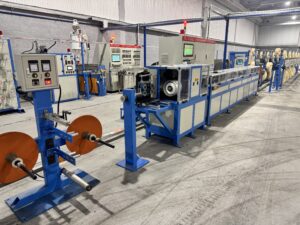
Once, a domestic customer called saying the stranding pitch was off – set at 180 mm, but the actual measurement was only 165 mm.
I had him take a photo of the parameter page on the touchscreen and send it over. Looking at it, the pitch factor was still at the factory default of 1.000 – no problem there. Then I had him send a screenshot of the encoder feedback value – and I saw it immediately: the encoder coupling was loose.
The set screw on the coupling between the encoder and the motor shaft hadn’t been tightened properly. After extended operation, it had worked loose. The encoder’s feedback speed no longer matched the actual speed. The PLC thought the stranding head had made one full rotation, but it had only turned 0.9 turns. Pitch = Haul-off Speed ÷ Stranding Speed – with a smaller denominator, the pitch naturally came out too small.
“Stop the machine, open the encoder cover, tighten the coupling set screw, and then recalibrate the pitch factor.”
He did as instructed. Fifteen minutes later, he sent a message: “All good – measured five sections, all between 179.8 and 180.2.”
He asked me later: “How did you know it was the coupling and not something else?”
I told him – most equipment faults have simple causes: loose wires, untightened screws, dirty sensors. Check those first, then suspect the “big-ticket” items like PLCs and inverters. The manual lists “possible causes,” but the ones that actually occur most often are the most unremarkable ones.
Another case on a sheathing line.
The customer said the sheath concentricity was consistently off – wall thickness was thicker on one side and thinner on the other. They had adjusted the die, replaced it with a new one, and re-centered the core and sleeve – but the problem persisted.
I asked if they had checked the laser diameter gauge data. They said yes – the outer diameter reading kept fluctuating, but within a small range.
“Have you cleaned the gauge lens?”
“Yes – every day before startup.”
“What do you clean it with?”
“A rag.”
I pointed my phone camera at a bottle of alcohol swabs in the workshop: “Use these next time. Lenses get oil film on them – a rag won’t remove it.”
He was skeptical. Two days later, he called back: “It really was the lens. After cleaning it with an alcohol swab, the readings stabilized, and the concentricity returned to normal.”
The laser diameter gauge on the sheathing line has an accuracy of 0.2 μm. A speck of dust or a film of oil on the lens can skew the reading by 0.01 mm. If the PLC thinks the outer diameter is too large, it reduces extruder speed; if it thinks it’s too small, it increases speed. In reality, the outer diameter is fine – the gauge is simply “seeing wrong.”
This case later became part of our internal training material: when troubleshooting equipment, check whether sensors are clean first, and only then suspect the control logic.
In the last two years, more and more calls have been about high-fiber-count cables.
With the rise of AI data centers, demand for high-fiber-count ribbon cables has surged. But many cable factories’ old stranding machines can’t keep up. Their pay-off tension control is open-loop – set a value and forget it, with no visibility into whether the actual tension has drifted. With dozens of tubes paying off simultaneously, if any one tube’s tension drifts, the entire cable is scrap.
One customer tried running high-fiber-count orders on an old stranding machine – pitch deviation exceeded ±0.3 mm, scrapping several reels a day. He asked if I could fix it. I said no – it wasn’t a matter of replacing a part; the old equipment’s control architecture simply didn’t support closed-loop tension control.
Later, he replaced it with a new machine. Hongkai’s SZ stranding machine uses independent servo motors for active pay-off with real-time closed-loop tension sensor control – measured pay-off tension fluctuation ≤ ±0.4 N and stranding pitch deviation ≤ ±0.08 mm.
I was on-site the day of commissioning. On the first trial run, pitch deviation was 0.09 mm. The customer measured three sections with a caliper – every point was within tolerance. He didn’t say much – just jotted the numbers down in his notebook.
Over the years working with cable equipment, I’ve come to believe that whether equipment performs well isn’t determined by what’s written in the manual – it’s determined on the production floor. A fault might be caused by a rat chewing through a wire, an oil film on a lens, or a loose set screw on a coupling. Troubleshooting these issues doesn’t require advanced technology – it requires experience and patience.
About Hongkai
Guangdong Hongkai Optical Cable Equipment Technology Co., Ltd. began manufacturing wire and cable equipment in 2005 and was formally incorporated in 2015. Our main products include SZ stranding and cabling lines, fiber optic cable sheathing extrusion lines, and FTTH drop cable production lines.
Every machine comes with a factory test report, a PLC program backup on USB, bilingual operation manuals (Chinese/English), and a wear-parts kit. Our equipment has been exported to more than 15 countries and regions, with over 160 sets currently running on production lines worldwide.