Cable plant owners have had a good year this year. AI data centers are being built, 5G is rolling out, and cable prices have multiplied several times since the end of last year.
With business booming, many are thinking about expanding capacity. But an optical cable production line isn’t something you can start with just one machine – from fiber entering the plant to finished cable leaving, there are several steps, and each requires specialized equipment.
Today, let’s walk through the whole process – what equipment you actually need for a complete optical cable production line.

Step 1: Fiber Coloring and Rewinding Machine – “Dressing” the Fiber
When fiber comes out of the preform, it’s transparent – every strand looks identical. To distinguish between different fibers during production, they need to be colored – red, blue, green, yellow, white, grey, black, brown, purple, pink, turquoise, and orange – 12 standard colors.
The fiber coloring and rewinding machine does exactly this. It applies color to the transparent fiber and rewinds it onto standard spools.
When choosing a coloring machine, pay attention to:
-
Speed: Mainstream speeds are 1,500–3,000 m/min
-
Tension stability: Fiber is fragile – too much tension breaks it, too little makes it loose. Typically controlled between 0.3–1.5 N
-
UV curing quality: The ink used for coloring is cured by UV lamps – lamp quality directly determines color fastness
In short: the coloring machine is the first step in cable production – it makes fibers identifiable.
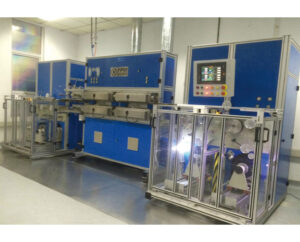
Step 2: Fiber Secondary Coating Line – “Jacketing” the Fiber
Colored fiber can’t be used directly. A single cable often contains multiple fibers, so they need to be bundled into tubes – that is, extruding a plastic tube around the fibers and filling it with water‑blocking gel.
This process uses a fiber secondary coating line.
The secondary coating line does three main things:
-
Pay off the colored fibers from their spools
-
Extrude a PBT or PP plastic tube around them
-
Fill the tube with fiber gel for waterproofing
When choosing a secondary coating line, focus on:
-
Fiber count capacity: Typically 1‑12 cores, some up to 24
-
Excess length control: Fiber shouldn’t be too tight or too loose inside the tube – excess length control is the core technology
-
Line speed: Slow speed limits capacity
In short: the secondary coating line turns loose fibers into “tubes” – the building blocks of the cable core.
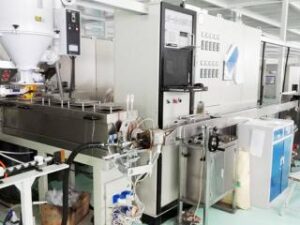
Step 3: SZ Stranding Line – “Twisting” Tubes into a Core
Once the tubes are ready, the next step is to twist multiple tubes together with strength members (steel wire or FRP) to form the cable core. This process is called stranding.
The equipment used is the SZ stranding line.
Why SZ? Because the twisting alternates – one turn forward, one turn backward – creating a pattern that looks like alternating S and Z shapes.
Key metrics for an SZ stranding line:
-
Tension stability: Pay‑off tension for each tube must be stable; fluctuations cause pitch inaccuracy
-
Pitch accuracy: Stranding pitch is the “skeletal parameter” of the cable – if deviation is too large, fiber stress becomes uneven
-
Tube capacity: Typically 6‑12 tubes; high‑fiber‑count cables need more
Hongkai’s SZ stranding line achieves pay‑off tension fluctuation ≤ ±0.4 N and pitch deviation ≤ ±0.08 mm, handling up to 12 tubes simultaneously.
In short: the SZ stranding line twists tubes into a core – the cable’s “skeleton.”
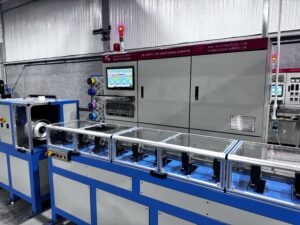
Step 4: Optical Cable Sheathing Line – “Armoring” the Core
With the core ready, the final step is applying the sheath. The sheath is the cable’s “armor” – it protects the internal fibers from moisture, compression, and tensile stress.
This process uses an optical cable sheathing line.
A sheathing line consists of:
-
Pay‑off stand: Feeds the cable core
-
Extruder: Melts and extrudes sheath material (PE, PVC, LSZH, etc.) around the core
-
Cooling trough: Cools and sets the freshly extruded sheath
-
Capstan: Pulls the cable forward
-
Take‑up: Winds the finished cable onto reels
When choosing a sheathing line, focus on:
-
Concentricity: The sheath must be centered – off‑center means uneven wall thickness. Requirement: ≥98%
-
Wall thickness tolerance: Typically within 0.05 mm
-
Material versatility: Can it handle PE, PVC, and LSZH?
-
Diameter gauge: A laser gauge monitors outer diameter in real time and automatically adjusts if it drifts
Hongkai’s sheathing line achieves concentricity of 98.6% and wall thickness tolerance ≤0.04 mm.
In short: the sheathing line “armors” the core – it’s the final step in cable production.
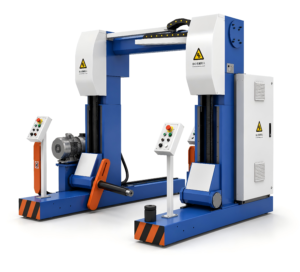
A Complete Production Line – Four Machines in Series
Putting the four steps together, a complete optical cable production line looks like this:
Fiber Coloring & Rewinding Machine → Secondary Coating Line → SZ Stranding Line → Sheathing Line
Fiber comes in, gets colored; colored fiber is made into tubes; tubes are stranded into a core; the core is sheathed – and the finished cable comes out.
Each step has its own requirements: coloring needs speed and stability; secondary coating needs precision and uniformity; stranding needs tightness and evenness; sheathing needs consistent wall thickness and high concentricity. If any step goes wrong, the final cable won’t pass quality standards.
What if you want to make FTTH drop cables?
The above describes a standard layer‑stranded cable line. If you mainly make FTTH drop cables (the flat butterfly cables used for fiber‑to‑the‑home), the equipment mix is slightly different.
An FTTH drop cable line typically includes:
-
Steel wire pay‑off
-
Strength member pay‑off
-
Fiber pay‑off (2 or more)
-
Extruder (with a dedicated die for the butterfly cross‑section)
-
Cooling trough
-
Capstan
-
Diameter gauge
-
Inkjet printer
-
Automatic reel changer
The core of a drop cable line is the extrusion die – it shapes the sheath into a flat butterfly profile, with fiber in the middle and strength members on both sides.
When choosing an FTTH drop cable line, focus on:
-
Single‑core and dual‑core capability – the most common specifications
-
Multi‑core capability – some customers need 12 or even 24 cores
-
Level of automation – can it interface with an MES system?
-
Changeover speed – how easy is it to switch between specifications?
About Hongkai
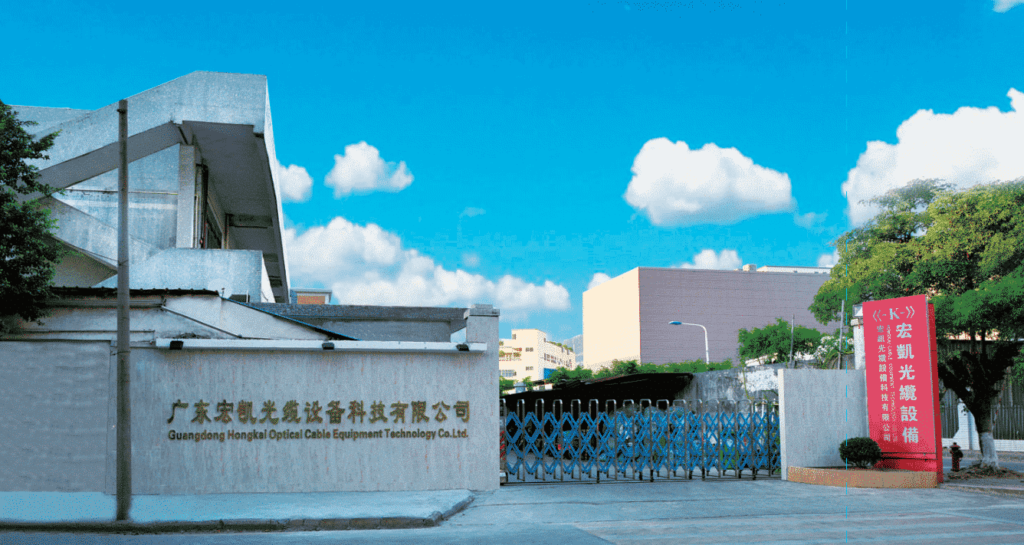
Guangdong Hongkai Optical Cable Equipment Technology Co., Ltd. started in cable equipment in 2005 and was formally established in 2015. We specialize in SZ stranding lines, optical cable sheathing lines, and butterfly drop cable lines.
Hongkai does not manufacture coloring machines or secondary coating lines – we focus on what we do best: stranding and sheathing.
Stranding and sheathing are the downstream processes in cable production, and they are critical for determining the cable’s mechanical properties and temperature performance. Hongkai has built solid precision and stability in these areas – stranding lines with tension fluctuation ≤ ±0.4 N and pitch deviation ≤ ±0.08 mm; sheathing lines with concentricity of 98.6% and wall thickness tolerance ≤0.04 mm.
If you are building an optical cable production line, or if you already have upstream equipment and need matching stranding and sheathing machinery, feel free to reach out to the Hongkai technical team. Start by reviewing our factory inspection reports and actual performance data – then decide if we’re the right fit.