When you buy equipment, what do you fear most?
It’s not the high price, and it’s not slow delivery. It’s when the equipment arrives and the precision doesn’t meet the standard.
An SZ stranding line – the quotation says “high tension control accuracy,” but in actual operation the pay-off tension fluctuation is ±1.5 N. A fiber optic cable sheathing line – the manufacturer says “good concentricity,” but the actual product has wall thickness that is thick on one side and thin on the other. The equipment money is spent, the production line can’t run, and orders can’t be delivered.
Where’s the problem? Before delivery, was the precision ever actually verified?

1. Precision Is Not a “Promise” – It’s “Data”
Third-party testing agencies in the industry focus on the following core parameters for cable equipment: tension control accuracy ±0.5 N, stranding pitch deviation ≤ ±0.1 mm, sheath concentricity ≥ 98%, and attenuation change ≤ 0.03 dB/km after 10 temperature cycles from -40°C to 70°C.
These numbers aren’t arbitrary – they have specific test methods. Precision verification for a fiber optic cable making machine must be collected by sensors and measuring instruments during actual load operation, not just “filled in” on a quotation sheet.
How Is the Precision of an SZ Stranding Line Measured?
Tension fluctuation: Use a dynamic tension meter with accuracy no less than 1 N to directly measure the pay-off tension fluctuation range during load operation at a line speed of 20 m/min.
Stranding pitch deviation: Take a section of stranded cable core and use a steel ruler with accuracy no less than 1 mm to directly measure the distance of a single helix.
SZ reversal angle: Mark any point on the stranding unit, observe the reversal point, and measure with a protractor.
How Is the Precision of a Fiber Optic Cable Sheathing Line Measured?
Concentricity: Cut a cross-section of the sheathed cable and examine wall thickness under a microscope. Compare the thinnest and thickest points. Industry standards require concentricity inner/outer layer deviation ≤ 0.05 mm.
Wall thickness tolerance: Measure thickness at 6 points evenly distributed around the cross-section circumference, take the arithmetic average; tolerance range ±0.1 mm.
What About the Precision of a Fiber Coloring Machine and Secondary Coating Line?
The core indicator of a fiber optic coloring line is pay-off tension accuracy – industry standard ±0.05 N.
The core indicator of a loose tube line is excess length control accuracy – industry standard ±0.2‰.
These data must all be actually measured during equipment load operation and recorded in the factory test report.
2. Factory Test Report: The Equipment’s Precision “Health Report”
Every fiber optic cable making machine should come with a complete factory test report. What’s written on that report determines whether there is a “basis” after the equipment reaches the customer.
A qualified factory test report should include at least:
-
Equipment model and factory serial number
-
Load test operating conditions (line speed, material specifications)
-
Measured pay-off tension fluctuation
-
Measured stranding pitch deviation
-
Measured sheath concentricity
-
Measured maximum production speed
-
Noise, vibration, and temperature rise data for each unit
Before leaving the factory, every Hongkai machine undergoes no less than 2 hours of load testing under simulated real production conditions. The data collected is recorded in the factory test report – pay-off tension fluctuation, stranding pitch deviation, sheath concentricity – all listed.
SZ stranding machine measured data: Pay-off tension fluctuation ≤ ±0.4 N, stranding pitch deviation ≤ ±0.08 mm.
Fiber optic cable sheathing line measured data: 8-hour continuous production concentricity average ≥ 98.6%, wall thickness tolerance ≤ 0.04 mm.
FTTH optical cable manufacturing machine: Extrusion material compatible with PVC and LSZH, capable of producing single-core and dual-core butterfly drop cables.
Indoor optical fiber production line: Uniform tight buffer thickness, pay-off tension control accuracy ±0.05 N.
These figures are not arbitrary – they are actually measured by sensors and instruments during load operation. Customers can replicate the measurements upon receipt – if the numbers match, the equipment’s precision is proven.
3. New Fiber Types Are Raising the Precision Bar
In 2026, fiber products themselves are changing, placing new precision demands on fiber optic cable production lines.
No-binder-yarn cables are becoming a trend. Yangtze Optical Fiber and Cable (YOFC) has published a patent for “no-binder-yarn loose-tube optical cable and its manufacturing system.” With binder yarn eliminated, stranding precision requirements are even higher – the core is held together by the shrink force of the sheath. If stranding precision is insufficient, the core won’t be round.
Hollow-core fiber is moving toward commercialization. Far East Communications, in its tender for supporting equipment for hollow-core fiber production, explicitly required: the bending radius of guide wheels, measuring wheels, and dancer wheels on rewinding equipment must be ≥ 7.5 cm. Hollow-core fiber is more fragile than traditional solid-core fiber; equipment must run more smoothly.
AI quality inspection is entering the workshop. China Unicom’s Yuanjing AI cable inspection all-in-one machine has been deployed at YOFC’s outer sheath production stage, achieving an overall defect detection rate 80% higher than manual inspection. Equipment data capability is no longer “optional” – it’s “standard.”
New sheath materials are being applied. FiberHome is using UV-curable resin to replace traditional thermoplastic extrusion materials, replacing high-temperature extrusion with a room-temperature layer-by-layer coating and UV curing process. Sheath materials are moving from single PE to diversification – equipment must be able to accommodate multiple materials.
As fiber products move toward higher speeds, larger capacities, smaller diameters, and lighter weight, tension control accuracy requirements during stranding have increased from ±5% to within ±2%. If equipment precision is insufficient, good orders can’t be taken.
4. Selecting Equipment: Look at the Data First
When buying a fiber optic cable production line, don’t just look at “high precision” on the quotation.
Ask the manufacturer three questions:
First, can we see the factory test report? Does the report contain measured data for pay-off tension fluctuation, stranding pitch deviation, and sheath concentricity? Or does it just say “qualified”? Every Hongkai machine comes with a factory test report – all data listed.
Second, what are the core components? What material and heat treatment process are used for the differential gears? What brand are the bearings? What material is the screw? Hongkai differential gears: high-frequency hardening HRC 50–55, precision grinding roughness ≤ 0.8 μm; bearings SKF/NSK; screw 38CrMoAlA with nitriding treatment.
Third, how are changeover and data capabilities? Does the equipment have recipe storage? Can changeover be done with one-touch loading? Can it connect to MES? Hongkai equipment can store process parameters for up to 20 different products – changeover completed in 1.5 hours; standard Siemens/Mitsubishi PLC platform, supporting data acquisition and MES integration.
5. About Hongkai
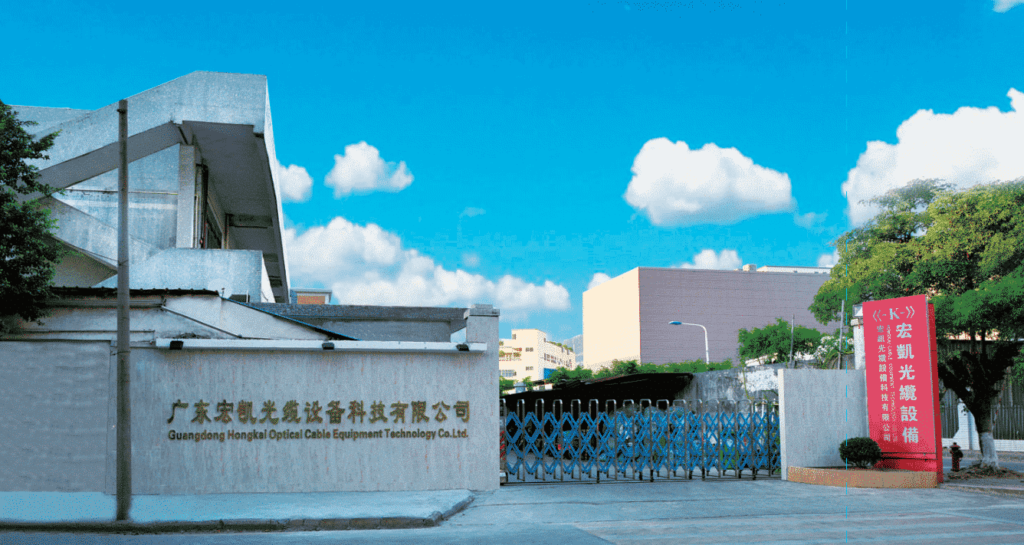
Guangdong Hongkai Optical Cable Equipment Technology Co., Ltd. began manufacturing wire and cable equipment in 2005 and was formally incorporated in 2015. Our main products cover the entire cable production process:
-
Fiber coloring machine / fiber optic coloring line: Coloring speed 3,000 m/min, pay-off tension accuracy ±0.05 N
-
Secondary coating line for optical fiber / loose tube line: Excess length control accuracy ±0.2‰, line speed 350 m/min
-
SZ stranding line: Pay-off tension fluctuation ≤ ±0.4 N, stranding pitch deviation ≤ ±0.08 mm, supporting simultaneous stranding of up to 12 tubes
-
Fiber optic cable sheathing line: 8-hour continuous production concentricity average ≥ 98.6%, wall thickness tolerance ≤ 0.04 mm
-
FTTH optical cable manufacturing machine: Compatible with PVC and LSZH, capable of producing single-core and dual-core butterfly drop cables
-
Indoor optical fiber production line: Adapted to data center cables and indoor soft cables
Every machine comes with a factory test report – pay-off tension fluctuation, stranding pitch deviation, sheath concentricity – all listed. A PLC program backup on USB, bilingual operation manuals (Chinese/English), and a wear-parts kit are shipped with the equipment. Our equipment has been exported to more than 15 countries and regions, with over 160 sets currently running on production lines worldwide.
If you are planning to build or expand a fiber optic cable production line, or want to see the factory test data for a particular machine, feel free to contact the Hongkai technical team. Look at the data first, then look at the equipment.