2026 年 10 月

Inline Inspection and Closed-Loop Control on Cable Equipment: Why Is “Real-Time Feedback” More Cost-Effective Than “Post-Production Inspection”?

For a long time, everyone’s focus has been on how much tension fluctuates, how much pitch deviates, and what the concentricity is. These figures are important, but there’s another question that’s often overlooked: how are these precision levels maintained?

Inline Inspection and Closed-Loop Control on Cable Equipment: Why Is “Real-Time Feedback” More Cost-Effective Than “Post-Production Inspection”? Read More »

What Are the Core Strengths of Each Key Machine on a Fiber Optic Cable Production Line?

When procuring cable equipment, many customers get overwhelmed by a pile of parameters and component brands. But what truly determines whether an optical fiber cable production line can consistently produce qualified cable is the functional design and process capability of each core machine itself.

As a Premier Cable Machine Manufacturer, Hongkai’s equipment covers the complete process from fiber coloring, secondary coating, loose tube, SZ stranding and cabling, to sheathing extrusion. This article doesn’t dwell on details like bearing brands or fastener materials – it focuses on clarifying: what are the core functions of each key machine in the fiber optic cable making machine series, where are their advantages, and what do they mean for cable quality?

What Are the Core Strengths of Each Key Machine on a Fiber Optic Cable Production Line? Read More »

Verification of Alternative Spare Parts for Overseas Cable Factories: Can Locally Purchased Bearings, Belts, and Sensors Really Be Used?

A while ago, I received a call from an overseas customer: “Hello, a bearing on the equipment has failed. Shipping from China takes three days. There’s a similar model available in the local market – can we use it temporarily?”

Verification of Alternative Spare Parts for Overseas Cable Factories: Can Locally Purchased Bearings, Belts, and Sensors Really Be Used? Read More »

The “First Article Confirmation” for Fiber Optic Cable Equipment: Why Must the First Reel of Cable Be Inspected Item by Item?

After a factory changes over, operators often go straight to ramping up speed and running volume. The first reel of cable comes off the line, they glance at the surface, see no major issues, and keep running. By the time they’ve run several kilometers, the customer’s sampling inspection finds the pitch is off and the concentricity is insufficient – and the entire reel is scrapped.

The “First Article Confirmation” for Fiber Optic Cable Equipment: Why Must the First Reel of Cable Be Inspected Item by Item? Read More »

The Cooling System of Fiber Optic Cable Equipment: A 2°C Water Temperature Difference – How Much Does It Affect Sheath Quality?

Recently, I’ve noticed that when customers select equipment, their attention is all on the extruder, screw, and laser diameter gauge. Few seriously ask: “What is the water temperature control accuracy of the cooling trough? Are there water quality requirements?”

The Cooling System of Fiber Optic Cable Equipment: A 2°C Water Temperature Difference – How Much Does It Affect Sheath Quality? Read More »

A “Strange Pitch Fault” on a Fiber Optic Cable Production Line: I Flew 12 Hours to Turkey and Found the Root Cause Wasn’t the Stranding Machine

A while ago, a Turkish customer, Murat, sent me an urgent WhatsApp voice message.

“The pitch on my SZ stranding line keeps fluctuating – big, then small. The scrap rate has jumped from 1% to 5%. My customer is pushing for delivery. Can you come and take a look?”

A “Strange Pitch Fault” on a Fiber Optic Cable Production Line: I Flew 12 Hours to Turkey and Found the Root Cause Wasn’t the Stranding Machine Read More »

Annual Equipment Audit for Cable Factories: Five Dimensions to Decide Whether to Repair, Retrofit, or Replace

Over the years in cable equipment, I’ve noticed a common habit among many factories: if the equipment isn’t broken, ignore it; if it breaks, figure something out.

But equipment doesn’t fail “suddenly.” Precision degrades, energy consumption rises, spare parts become harder to source, and safety guards age – these problems are not obvious day to day, but when they erupt all at once, the result is unplanned downtime and breached orders.

An annual equipment audit is far more cost-effective than firefighting after something goes wrong.

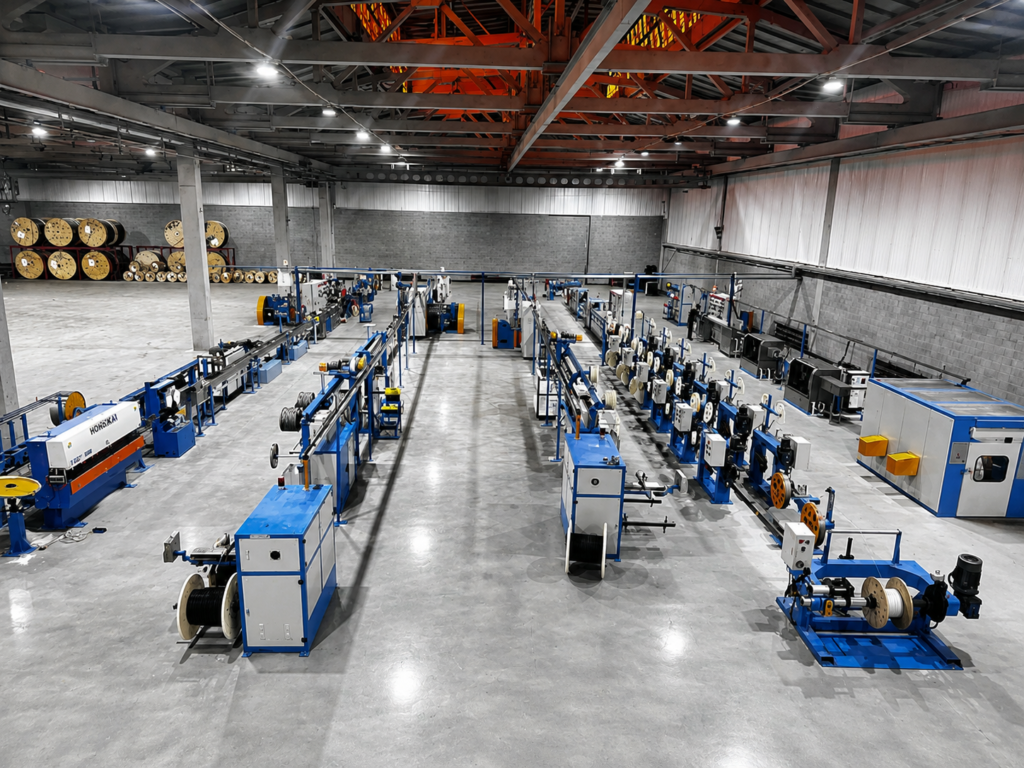
Today, using a fiber optic cable production line as an example, let’s go through the five dimensions of an annual equipment audit to help overseas factories decide whether existing equipment should be repaired, retrofitted, or replaced. As a Premier Cable Machine Manufacturer, Hongkai has accumulated substantial on-site experience in equipment audits and upgrade plans.

Annual Equipment Audit for Cable Factories: Five Dimensions to Decide Whether to Repair, Retrofit, or Replace Read More »

A 15-Minute Daily Inspection at Cable Factories Can Prevent 80% of Unplanned Downtime

Before equipment develops major problems, there are actually small warning signs.

The tension curve on an SZ stranding line starts fluctuating slightly. The sheath surface on a fiber optic cable sheathing line occasionally looks a bit dull. The UV lamp brightness on a fiber coloring machine isn’t what it used to be – these are all the equipment “talking.” But when operators get busy, they often don’t have time to look. By the time the equipment alarms and stops, it’s already too late.

Today, let’s share a 15-minute daily inspection route. Walk through it process by process, and eliminate faults while they’re still in the bud. As a Premier Cable Machine Manufacturer, Hongkai trains customer operators to master this inspection method during equipment delivery.

A 15-Minute Daily Inspection at Cable Factories Can Prevent 80% of Unplanned Downtime Read More »

Opening Hours

Monday – Saturday 8am – 11pm

Contact

滚动至顶部
Leave Your Message