HongKai

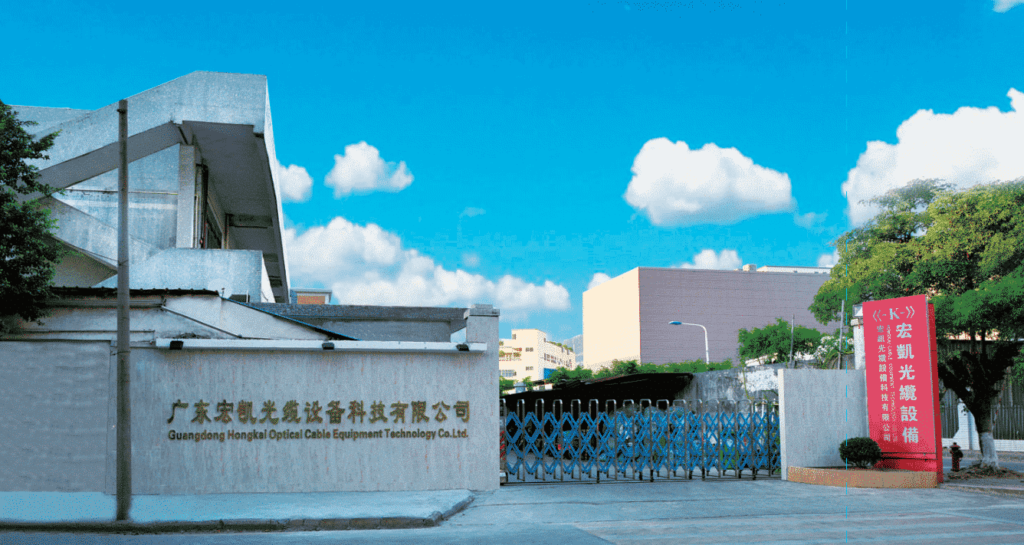
Guangdong Hongkai Optical Cable Equipment Technology Co. Ltd is a specialized provider of high-quality cable manufacturing equipment, renowned for delivering exceptional performance and innovative solutions. If you are looking for a professional manufacturer who makes Optic Cable, Electric Cable, and Network Cable machines, you are in the right place. HONGKAI group opened its door in 2005 as an optic cable machine manufacturer cum a turn-key optic cable production service provider in Guangdong province, China.

The Complete Manufacturing Process of a Cable Machine: Six Checkpoints from Design to Factory Release

When cable factories buy equipment, their main concerns are price, accuracy, and delivery time. But few stop to consider – from blueprints to a fully operational machine, how many steps does an SZ stranding and cabling line or a sheathing extrusion line actually go through?

Cable equipment is not “building blocks.” A stranding machine weighs dozens of tons and contains hundreds of components. From design to factory release, every step is governed by strict standards. The national standard Code for Construction and Quality Acceptance of Production Equipment Installation Engineering in Optical Fiber Cable Factories (GB 50950‑2013) specifies clear requirements for cable equipment manufacturing and acceptance – equipment performance inspection must be conducted after load operation is completed, and an acceptance report must be issued. This standard applies to fiber coloring machines, secondary coating lines, stranding lines, sheathing lines, and other cable production equipment.

Below, starting from the design phase of a cable machine, we break down the complete manufacturing process.

The Complete Manufacturing Process of a Cable Machine: Six Checkpoints from Design to Factory Release Read More »

The “Precision Code” in Fiber Optic Cable Equipment Manufacturing: From 0.01 mm to 0.2 μm

There’s a saying in the fiber optic cable industry: “Even a 0.1°C temperature deviation or a 0.01 mm dimensional error can affect the ultimate transmission speed and stability of the fiber.”

Anyone in the cable business knows the weight of that statement. But few stop to consider that the equipment used to make those cables has precision requirements no less demanding than the cables themselves.

An SZ stranding and cabling line must control the tooth surface roughness of differential gears to within 0.8 μm. A fiber optic cable sheathing line must achieve laser diameter gauge accuracy of 0.2 μm. A tension control system must keep fluctuation within ±0.5%.

These numbers are the “precision code” of cable equipment.

The “Precision Code” in Fiber Optic Cable Equipment Manufacturing: From 0.01 mm to 0.2 μm Read More »

Next-Generation Optical Cables Are Reshaping Equipment Demands: Hollow-Core Fiber and Multicore Fiber Are Coming – Can Stranding and Sheathing Equipment Keep Up?

In January 2026, Matt Rehder, Vice President of Core Networking at AWS, announced that AWS had successfully deployed hollow-core fiber to connect its 10 core data centers, marking the official commercial-scale adoption of hollow-core fiber. That same month, Yangtze Optical Fiber and Cable (YOFC) officially launched its hollow-core fiber brand HollowBand at MWC 2026, achieving a world-record low attenuation of 0.04 dB/km.

During the same period, cable fiber count records are being continuously broken. In June 2026, ZTT released a 17,280‑fiber ultra‑high‑density optical cable with an outer diameter of just 45 mm – a 60‑fold increase in transmission capacity over traditional 288‑fiber cables, reducing duct space occupancy by 92% at equivalent capacity.

Optical cables are changing – becoming more sophisticated, more delicate, and placing higher demands on manufacturing equipment. Next‑generation cables are here, and the equipment that makes them must evolve too.

Next-Generation Optical Cables Are Reshaping Equipment Demands: Hollow-Core Fiber and Multicore Fiber Are Coming – Can Stranding and Sheathing Equipment Keep Up? Read More »

All Sorts of Things I’ve Encountered in After-Sales Service for Cable Equipment

Over the years in after-sales service, I’ve encountered all sorts of customers. But one incident stands out more than any other.

I got a call from a customer in Southeast Asia – their sheathing line had been down for nearly two days.

The fault was very typical: the extruder could still heat up, the screw could still rotate, but the capstan and take-up were out of sync – the machine would alarm as soon as it started. The customer’s electrician had spent a full day troubleshooting – checked the wiring, replaced relays, rebooted the PLC – but nothing worked. Eventually, they concluded the PLC was faulty and were preparing to order a replacement.

I said: “Hold on – don’t rush to replace anything. Let me take a look via video call.”

“Open the control cabinet door – let me see the wiring.”

After the video connected, I had him open the control cabinet and go through the wiring. The wire labels were clear, nothing was loose, and there were no burn marks.

“Do you have a multimeter?”

He said yes. I had him set it to voltage and check the 24V supply to the PLC output module – it was normal. Then I had him check the analog input terminals on the inverter – no voltage.

“The signal isn’t getting through,” I said. “Trace this wire back and see if there’s a break somewhere.”

He searched for a while and found a section of cable between the control cabinet and the capstan motor – chewed by rats. The insulation was broken, and two wires had shorted together. After reconnecting them properly, the machine returned to normal. Total time: less than an hour.

The customer laughed on the other end of the video: “So a rat cost me two days of production!”

Later, he told me he had contacted other manufacturers, and their first reaction was “replace the PLC module” – quoting over 20,000 RMB and a week’s wait for shipping. He didn’t spend a single cent on new parts, and the problem was solved.

All Sorts of Things I’ve Encountered in After-Sales Service for Cable Equipment Read More »

The “Front-End” Processes of a Fiber Optic Cable Production Line: From Fiber Coloring to Loose Tube Forming – How to Choose the Right Equipment?

Most people in the cable industry are familiar with SZ stranding and cabling lines and sheathing extrusion lines – after all, they are the “star players” in cable stranding and sheathing. However, many overlook the “front-end” processes of cable production: fiber coloring and secondary coating.

Without coloring, all fibers are transparent and indistinguishable during production. Without secondary coating, fibers lack the protection of loose tubes and would break easily during stranding.

These two processes are the “starting point” of a cable production line. If the starting point is done right, the subsequent stranding and sheathing processes will run smoothly.

The “Front-End” Processes of a Fiber Optic Cable Production Line: From Fiber Coloring to Loose Tube Forming – How to Choose the Right Equipment? Read More »

How a Fiber Optic Cable Machine Is Made: From Steel Plate Cutting to Factory Testing

People who work with optical cables deal with stranding machines and sheathing lines every day. But few have ever stopped to think – how are these machines themselves made?

An SZ stranding and cabling line weighs dozens of tons and contains hundreds of components. The journey from piles of steel plates and motors to a fully operational machine involves many steps.

Today, let’s talk about the manufacturing story behind cable equipment itself.

How a Fiber Optic Cable Machine Is Made: From Steel Plate Cutting to Factory Testing Read More »

Fiber Optic Cable Sheathing Lines: From Common Process Issues to Key Equipment Selection Points

The sheath is the cable’s “armor.” After the loose tubes are stranded into a core, an outer sheath must be applied to protect the optical fibers from moisture, compression, and tensile stress. The sheathing extrusion line is the final process in cable manufacturing – no matter how well the preceding stranding was done, if the sheathing fails, the entire reel is scrap.

But in actual production, sheathing processes often present more problems than one might expect. This article reviews the most common process issues on sheathing lines and the key points to watch when selecting equipment.

Fiber Optic Cable Sheathing Lines: From Common Process Issues to Key Equipment Selection Points Read More »

SZ Stranding and Cabling Line: The Core Equipe’wment for Optical Cable Stranding – Have You Made the Right Choice?

SZ stranding is a specialized stranding process used in optical cable manufacturing. The “S” and “Z” in its name represent alternating directions of twisting – one rotation forward (S‑direction), one rotation backward (Z‑direction), alternating continuously.

SZ Stranding and Cabling Line: The Core Equipe’wment for Optical Cable Stranding – Have You Made the Right Choice? Read More »

Troubleshooting Tips for Fiber Optic Cable Production Lines – Known Only to Seasoned Operators

Getting a cable production line up and running is one thing; keeping it running smoothly and reliably over the long haul is quite another.

Having worked with cable equipment for over a decade and interacted with hundreds of production lines, we’ve noticed a pattern: many unplanned stoppages aren’t actually because the equipment is “broken” – they happen because the operator doesn’t know how to handle the situation. When an experienced master is on shift, they can tell where the problem is just by listening to the machine. But when a new operator takes over, an alarm goes off and they’re stuck, forced to call the supplier for remote support.

Troubleshooting Tips for Fiber Optic Cable Production Lines – Known Only to Seasoned Operators Read More »

Opening Hours

Monday – Saturday 8am – 11pm

Contact

滚动至顶部
Leave Your Message