Guangdong Hongkai optical cable equipment

Before a Cable Machine Leaves the Factory: From No-Load to Load – How Many Checkpoints Must a Stranding Machine Pass?

When buying cable equipment, you look at specifications when signing the contract – and at data after the equipment arrives at your plant.

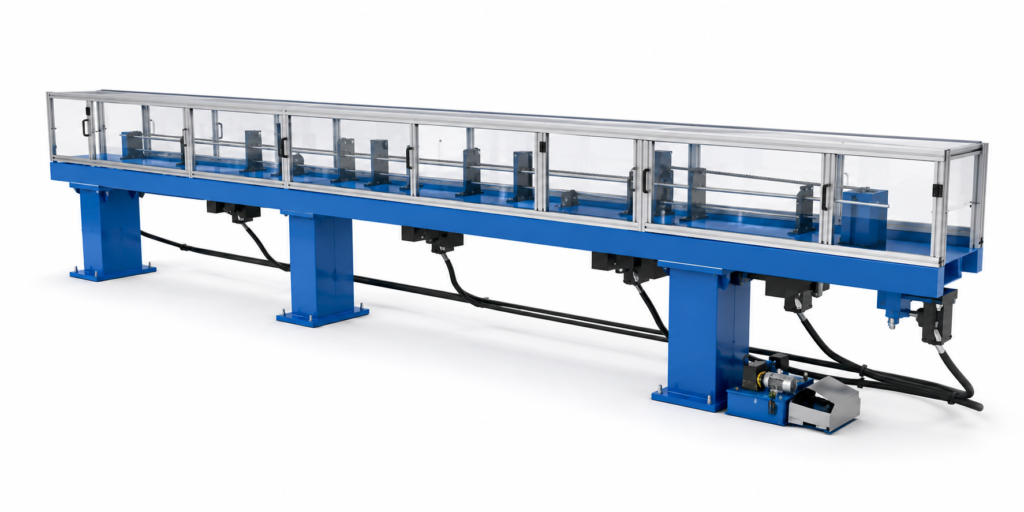
This means that before an SZ stranding and cabling line leaves the factory, it’s not enough that it’s “assembled and can run.” It must pass through three checkpoints: no-load trial run, load trial run, and performance inspection. Every set of data produced must be recorded and compared item by item against the contract technical documents.

Before a Cable Machine Leaves the Factory: From No-Load to Load – How Many Checkpoints Must a Stranding Machine Pass? Read More »

Cable Equipment Is “Shaking” – What’s Causing It? Five Vibration Sources You Can’t Afford to Ignore

When cable equipment has been in service for a while, it may suddenly start shaking. When that happens, do you panic?

A little more vibration or noise from a stranding machine, and operators might think, “It’s normal – old equipment is like this.” But vibration isn’t just “noise” – it’s an early warning signal from the equipment.

Vibration in a stranding machine can stem from five different problems. Guess wrong, and you can replace parts without fixing anything. Guess right, and tightening a single loose set screw solves the problem.

Cable Equipment Is “Shaking” – What’s Causing It? Five Vibration Sources You Can’t Afford to Ignore Read More »

The Ongoing Technical Evolution of Cable Equipment: From “Functional” to “Exceptional” – What’s Happening in Equipment Manufacturing?

Cable factories are racing to expand capacity – and the equipment manufacturers that supply them are evolving right alongside.

A 2025 study published in the journal Wire & Cable on the design of high‑speed stranding and cabling units pointed out that traditional stranding units in high‑speed cabling processes have shortcomings in speed, durability, accuracy, and digital interconnectivity. By adopting new servo motors, optimizing mechanical structures, improving materials, and enhancing informatization, the research team achieved significant increases in line speed, notable improvements in equipment durability, and effective control of stranding accuracy.

Equipment manufacturing itself is undergoing a technical evolution – from “functional” to “exceptional.”

The Ongoing Technical Evolution of Cable Equipment: From “Functional” to “Exceptional” – What’s Happening in Equipment Manufacturing? Read More »

Sheathing Extrusion: When the Material Changes, Can Your Equipment Keep Up?

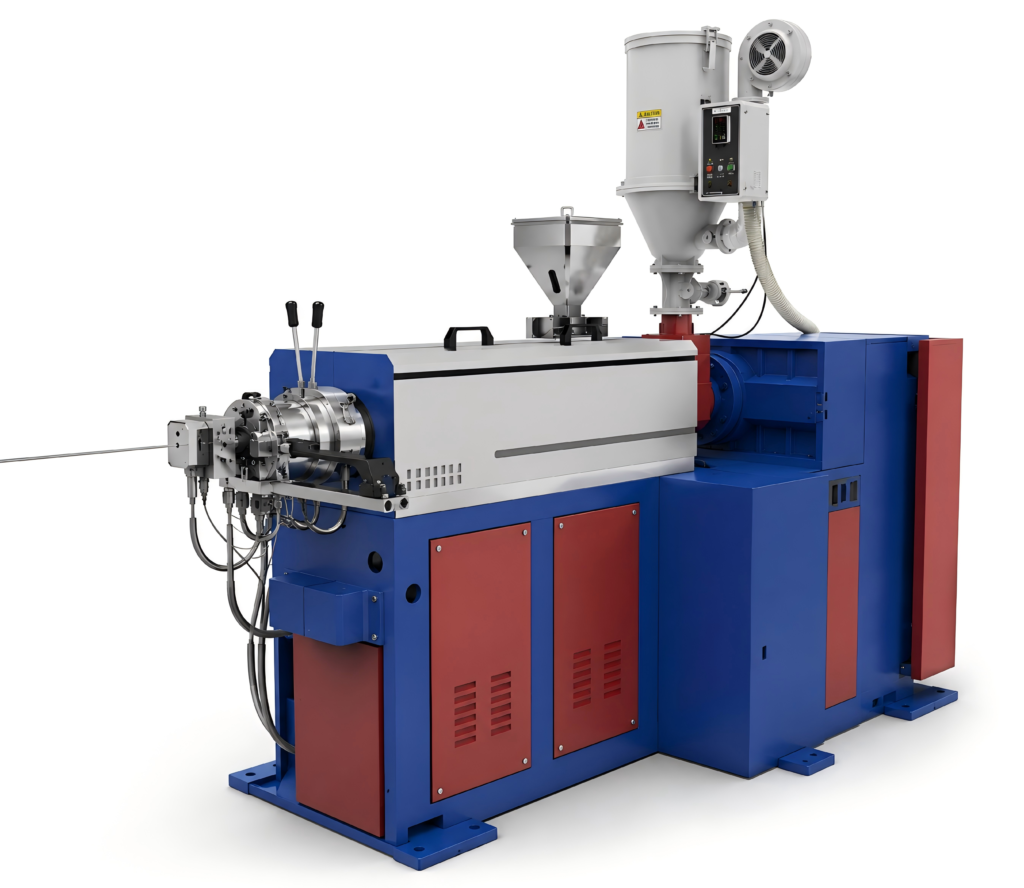
Sheathing extrusion looks simple – pour plastic pellets in, heat and melt, extrude over the cable core, cool and set.

But anyone who has actually run a production line knows it’s far more complicated than that.

Here’s a classic scenario: you’ve been running smoothly with one material for a long time. Then you switch to a new batch of material, and problems start. Surface pitting, porosity, unstable melt output – and issues crop up as soon as you increase speed. The operator adjusts temperatures, changes the screw, replaces the screen pack – and after hours of effort, still can’t fix it.

Where’s the problem? Material and equipment mismatch.

Sheathing Extrusion: When the Material Changes, Can Your Equipment Keep Up? Read More »

The “Precision Code” in Fiber Optic Cable Equipment Manufacturing: From 0.01 mm to 0.2 μm

There’s a saying in the fiber optic cable industry: “Even a 0.1°C temperature deviation or a 0.01 mm dimensional error can affect the ultimate transmission speed and stability of the fiber.”

Anyone in the cable business knows the weight of that statement. But few stop to consider that the equipment used to make those cables has precision requirements no less demanding than the cables themselves.

An SZ stranding and cabling line must control the tooth surface roughness of differential gears to within 0.8 μm. A fiber optic cable sheathing line must achieve laser diameter gauge accuracy of 0.2 μm. A tension control system must keep fluctuation within ±0.5%.

These numbers are the “precision code” of cable equipment.

The “Precision Code” in Fiber Optic Cable Equipment Manufacturing: From 0.01 mm to 0.2 μm Read More »

Next-Generation Optical Cables Are Reshaping Equipment Demands: Hollow-Core Fiber and Multicore Fiber Are Coming – Can Stranding and Sheathing Equipment Keep Up?

In January 2026, Matt Rehder, Vice President of Core Networking at AWS, announced that AWS had successfully deployed hollow-core fiber to connect its 10 core data centers, marking the official commercial-scale adoption of hollow-core fiber. That same month, Yangtze Optical Fiber and Cable (YOFC) officially launched its hollow-core fiber brand HollowBand at MWC 2026, achieving a world-record low attenuation of 0.04 dB/km.

During the same period, cable fiber count records are being continuously broken. In June 2026, ZTT released a 17,280‑fiber ultra‑high‑density optical cable with an outer diameter of just 45 mm – a 60‑fold increase in transmission capacity over traditional 288‑fiber cables, reducing duct space occupancy by 92% at equivalent capacity.

Optical cables are changing – becoming more sophisticated, more delicate, and placing higher demands on manufacturing equipment. Next‑generation cables are here, and the equipment that makes them must evolve too.

Next-Generation Optical Cables Are Reshaping Equipment Demands: Hollow-Core Fiber and Multicore Fiber Are Coming – Can Stranding and Sheathing Equipment Keep Up? Read More »

Fiber Optic Cable Sheathing Lines: From Common Process Issues to Key Equipment Selection Points

The sheath is the cable’s “armor.” After the loose tubes are stranded into a core, an outer sheath must be applied to protect the optical fibers from moisture, compression, and tensile stress. The sheathing extrusion line is the final process in cable manufacturing – no matter how well the preceding stranding was done, if the sheathing fails, the entire reel is scrap.

But in actual production, sheathing processes often present more problems than one might expect. This article reviews the most common process issues on sheathing lines and the key points to watch when selecting equipment.

Fiber Optic Cable Sheathing Lines: From Common Process Issues to Key Equipment Selection Points Read More »

Troubleshooting Tips for Fiber Optic Cable Production Lines – Known Only to Seasoned Operators

Getting a cable production line up and running is one thing; keeping it running smoothly and reliably over the long haul is quite another.

Having worked with cable equipment for over a decade and interacted with hundreds of production lines, we’ve noticed a pattern: many unplanned stoppages aren’t actually because the equipment is “broken” – they happen because the operator doesn’t know how to handle the situation. When an experienced master is on shift, they can tell where the problem is just by listening to the machine. But when a new operator takes over, an alarm goes off and they’re stuck, forced to call the supplier for remote support.

Troubleshooting Tips for Fiber Optic Cable Production Lines – Known Only to Seasoned Operators Read More »

The “Invisible” Details in Fiber Optic Cable Equipment Manufacturing: From the Differential Gearbox to the Laser Diameter Gauge

When cable factories buy equipment, they’re not buying hunks of metal – they’re buying precision, stability, and years of trouble‑free operation.

The core of an SZ stranding and cabling line is the differential gearbox – a cluster of meshing gears rotating forward and backward, tens of thousands of cycles per day. The quality of the differential gearbox directly determines how many years the stranding machine will last and whether the pitch stays accurate.

The core of a fiber optic cable sheathing extrusion line is the laser diameter gauge – if the sheath outer diameter deviates by just 0.01 mm, it detects it and automatically adjusts. The sensitivity of the gauge directly determines whether sheath concentricity can reach above 98%.

These “invisible” details are what make cable equipment truly valuable.

The “Invisible” Details in Fiber Optic Cable Equipment Manufacturing: From the Differential Gearbox to the Laser Diameter Gauge Read More »

Opening Hours

Monday – Saturday 8am – 11pm

Contact

滚动至顶部
Leave Your Message